
Introduction
Picture this: your new industrial machine is crated, inspected, and ready to ship to a customer's facility. The electrician arrives, opens the control panel door, and finds a nameplate—but it's missing the short-circuit current rating. Installation stops. The customer demands a field evaluation by a registered PE. What should have been a routine hookup becomes a multi-week delay and a costly compliance headache.
It's a scenario that plays out regularly across manufacturing floors and construction sites. Missing, incomplete, or improperly placed nameplates trigger failed electrical inspections, installation hold-ups, and regulatory penalties in both U.S. and European markets.
The rules differ by destination. For machinery sold in North America, NFPA 79 and NEC Article 670 govern nameplate requirements. Equipment entering the European Economic Area must carry CE marking under the EU Machinery Directive 2006/42/EC. Machines sold in both markets must satisfy both sets of requirements simultaneously.
This guide breaks down each standard's required data fields, material and placement specs, and the overlap points that catch manufacturers off guard — so your equipment clears inspection the first time.
TLDR: Key Takeaways
- NFPA 79 and NEC 670 require permanent nameplates with electrical specs (voltage, phase, full-load amps), SCCR rating, and manufacturer details
- CE marking requires the CE symbol (≥5mm tall), manufacturer info, machine designation, serial number, and year of construction on a durable plate
- Nameplate material must withstand the machine's full service life—anodized aluminum, stainless steel, and brass are common compliant choices
- Missing or illegible nameplates trigger inspection failures, installation delays, and penalties in U.S. and EU markets
What Information Must Appear on a Machine Nameplate?
Specific fields vary by standard, but all major regulations require the same core data categories: manufacturer identification, electrical ratings, and safety warnings. That holds whether you're building for a domestic facility or exporting to the EU.
Manufacturer and Equipment Identification
Every compliant nameplate includes:
- Manufacturer's full legal name and address
- Machine category or designation
- Model or type series
- Serial number
- Year of manufacture (cannot be pre-dated or post-dated under CE rules)
Serial numbers and model designations exist for traceability. When a safety recall is issued or a component fails, that number is how inspectors, manufacturers, and maintenance teams identify affected units — and how you demonstrate compliance during a regulatory audit.
Electrical and Operational Ratings
Core electrical data protects installers and ensures proper overcurrent protection sizing:
- Supply voltage - The nominal voltage required
- Number of phases - Single-phase or three-phase
- Frequency (Hz) - Typically 50 Hz (EU) or 60 Hz (U.S.)
- Total full-load current (FLA) - Combined amperage for all motors and equipment running simultaneously
- Short-circuit current rating (SCCR) - Maximum fault current the panel can safely withstand
If a machine has multiple supply circuits, provide nameplate data for each circuit separately. The electrician sizing the facility's feeder and breaker relies on this information to ensure safe, code-compliant installation.
Safety and Hazard Markings
Beyond electrical data, nameplates must include:
- Enclosure environmental type rating (NEMA 1, NEMA 4X, IP65, etc.)
- Electrical shock warning labels with voltage levels present
- Hot surface warnings for components exceeding safe touch temperatures
- Grounding point identification
- Explosive atmosphere markings (ATEX, Class/Division) if applicable
- Fuse table labels and device identification for components requiring maintenance (required under UL 508A and NFPA 79)
NFPA 79 Machine Nameplate Requirements Explained
NFPA 79 is the National Fire Protection Association's electrical standard for industrial machinery. Unlike the NEC (which governs building electrical systems), NFPA 79 specifically addresses electrical equipment and wiring on machines used in industrial settings—from CNC mills to packaging lines.
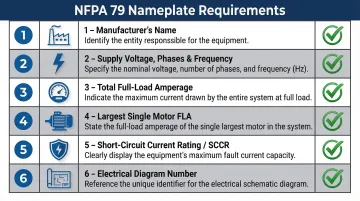
That scope makes the nameplate requirements highly specific. NFPA 79 clause 16.4.1 mandates that control equipment be "legibly and durably marked in a way that is plainly visible after the equipment is installed." The nameplate must include:
- Manufacturer's name
- Supply voltage, phases, and frequency
- Total full-load amperage (FLA) for all motors and heating loads
- Largest single motor FLA
- Short-circuit current rating (SCCR)
- Electrical diagram number or index
Core Required Data Under NFPA 79
NFPA 79 requires the nameplate to reflect the total connected load—not just individual component ratings. This distinction matters when an electrician sizes the facility's feeder and overcurrent device. If your machine has three motors (5A, 10A, and 15A) plus a 20A heater, the nameplate FLA must reflect the sum of all loads that can operate simultaneously.
The SCCR (Short-Circuit Current Rating) tells the installer the maximum available fault current the panel can safely withstand. The installer must verify that the SCCR meets or exceeds the available fault current at the installation point.
According to NFPA 79 clause 3.3.101, SCCR is "the prospective symmetrical fault current at a nominal voltage to which an apparatus or system is able to be connected without sustaining damage exceeding defined acceptance criteria."
Additional Labels and Warnings Required by NFPA 79
Beyond the main nameplate, NFPA 79 requires supplemental labeling:
- Warning labels on live parts accessible during maintenance
- Identification of all grounding points
- Cautionary markings for hot surfaces
- Labels on components requiring periodic replacement or recalibration
All labels must be permanently affixed to the machine structure (e.g., back panel), not to removable components, so they remain legible throughout the machine's service life.
NEC Article 670: Industrial Machinery Nameplate Data
NFPA 70 (the National Electrical Code), Article 670, covers industrial machinery as "special equipment" and includes its own nameplate requirements in Section 670.3. While NFPA 79 governs how the machine builder designs and labels the equipment, NEC 670 governs how the installer connects it to facility power and how the Authority Having Jurisdiction (AHJ) inspects it.
NEC 670.3(A) requires the following nameplate data:
- Supply voltage, phase, and frequency
- Full-load current for all motors and other equipment
- Ampere rating of largest motor or load
- Short-circuit current rating (SCCR)
- Maximum branch circuit overcurrent protective device rating (if overcurrent protection is provided as part of the machine)
One visibility rule catches many facilities off guard: the nameplate must be "attached to the outside of the control equipment enclosure or on the machine immediately adjacent to the main control equipment enclosure that is visible after installation." Nameplates placed inside control panel doors don't meet this requirement.
That visibility requirement applies to the OEM's scope — but responsibility doesn't stop there. NEC 670.5 requires field marking of the maximum available short-circuit current at the installation point, along with the date of calculation. The OEM's job ends with marking the SCCR. The facility owner must then verify and document that the available fault current doesn't exceed it.
CE Marking Requirements Under the Machinery Directive
The EU Machinery Directive 2006/42/EC establishes the regulatory framework requiring CE marking on machinery sold or put into service in the European Economic Area. CE marking demonstrates the manufacturer's declaration that the machine meets all applicable EU health, safety, and environmental requirements.
CE marking is not a quality mark or third-party certification for most machines—it's a self-declaration by the manufacturer. The exception: "Annex IV" high-risk machinery categories (such as circular saws, vehicle servicing lifts, and certain guarding logic units) require a Notified Body's identification number to appear alongside the CE mark.
What Must Appear on the CE Marking Plate
Annex III of the Machinery Directive lists required plate contents:
- The 'CE' symbol in the prescribed graphical style
- Manufacturer's full business name and address (and authorized representative's details if applicable)
- Machine designation or category
- Manufacturer's type or series designation
- Machine serial number (if assigned)
- Year of construction (the year manufacturing was completed)
- Markings required for use in potentially explosive atmospheres (if applicable)

Minimum size requirement: The vertical dimension of the CE letters must be no less than 5mm, except on small-scale machinery. All text and markings should be proportional to the machine's size to ensure legibility.
The CE marking must be placed "in the immediate vicinity" of the manufacturer's name and applied using the same technique (e.g., both etched, both stamped). This is why all required information is typically consolidated onto a single CE marking plate.
Physical and Permanence Requirements for CE Plates
The CE marking and all plate information must be "visible, legible, and indelible" throughout the entire service life of the machine. The marking method must be appropriate to the operating environment—resistant to steam cleaning, chemicals, or outdoor exposure as applicable.
The official Machinery Directive guidance states that recommended attachment methods include welding, riveting, and bonding—not threaded fasteners. Fasteners are excluded because they can be removed, which compromises the permanent marking requirement.
Nameplate Material, Durability, and Placement
Regulatory "permanence" comes down to material selection, marking method, and attachment technique — all three must work together for a nameplate to hold up in service.
Material Options
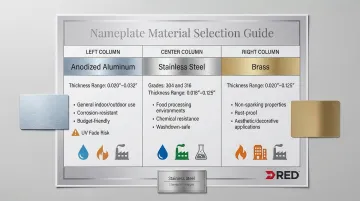
Anodized Aluminum (0.020"–0.032" thick): The go-to for general indoor/outdoor industrial use. Corrosion-resistant, lightweight, and budget-friendly — holds up to steam cleaning and petroleum exposure. Note: untreated surfaces can fade under prolonged UV exposure.
Stainless Steel (Grades 304 or 316, 0.018"–0.125" thick): Built for demanding environments. Food processing, coastal installations, and heavy washdown zones all call for stainless. Grade 316 is the right choice where harsh chemicals are present; Grade 304 handles most other industrial conditions.
Brass (0.020"–0.125" thick): Rustproof and non-sparking, which makes brass the preferred choice in environments where spark hazards are a concern. Also selected for aesthetic applications where appearance matters alongside function.
Once you've selected the right material, correct placement determines whether that nameplate actually meets compliance requirements.
Placement Best Practices
The nameplate must be:
- Visible after installation (per NEC 670)
- Affixed to a permanent, non-removable surface of the machine structure
- Positioned where it won't be obscured by guards, covers, or installed components
- On the exterior of the machine (for CE compliance)
For multi-panel machinery, place the main nameplate on the primary control panel connected to the facility's supply conductors.
RE&D has manufactured custom nameplates to NFPA and CE specification requirements for over 33 years. Manufacturers and facilities teams needing compliant, durable solutions can reach their technical team at 1-800-552-3127 or sales@redsafetyids.com.
Frequently Asked Questions
What are the requirements for a name plate?
All machine nameplates must include manufacturer identification, key electrical ratings (voltage, phase, frequency, full-load amps), and safety markings. Beyond that, requirements depend on the applicable standard: U.S. machinery must comply with NFPA 79 and/or NEC Article 670, while equipment sold in the EU must carry CE marking per Machinery Directive 2006/42/EC.
What is the NFPA 79 label?
The NFPA 79 label is a permanent marking required on industrial machinery. It lists the manufacturer's name, supply voltage, phases, frequency, total full-load amperage, largest motor FLA, and short-circuit current rating — all governed by NFPA's electrical standard for industrial machinery.
How is NFPA 79 different from NEC Article 670.3 for machine nameplates?
NFPA 79 is the machine builder's standard — it governs how electrical equipment is designed and labeled. NEC Article 670 is the installer and inspector's standard, covering how industrial machinery connects to facility power. Both require similar nameplate data but apply to different compliance audiences.
Does CE marking apply in the United States?
CE marking is an EU requirement and is not mandated by U.S. law. However, manufacturers exporting machinery to Europe or EEA countries must comply with the Machinery Directive 2006/42/EC. Some manufacturers voluntarily apply both NFPA and CE-compliant nameplates for equipment shipped across markets.
What material should machine nameplates be made from?
Anodized aluminum, stainless steel, and brass are the standard choices. Stainless steel is preferred for chemical or high-moisture environments; brass is used where non-sparking properties are required. All materials must remain legible for the machine's full service life.
What happens if a machine nameplate is missing or unreadable?
A missing or illegible nameplate can result in failed electrical inspections, installation hold-ups, regulatory non-compliance penalties, and safety hazards. According to the City of Phoenix, if a nameplate is missing and available fault current exceeds 5,000 Amps, a costly field evaluation by a Field Evaluation Body is required before the machine can be energized.