Introduction: Why Construction Site Signage Is More Than Just a Legal Requirement
Every 104 minutes, a worker dies from a work-related injury in the United States. In the construction industry specifically, 1,032 fatalities were recorded in 2024—averaging 2.8 construction worker deaths every single day. Behind many of these tragedies lies a common thread: inadequate hazard communication, including missing, damaged, or improperly placed safety signage.
Construction site signage is a federal legal mandate under OSHA regulations—and a direct factor in whether workers go home safely. For contractors and site managers, getting signage right protects lives and signals responsible site management to regulators, insurers, and clients alike.
This guide walks through the full picture of signage compliance: OSHA standards, required sign types, placement rules, material considerations, and how to audit your site for gaps before OSHA does.
Key Takeaways
- OSHA requires construction sites to display compliant signs covering hazard warnings, access control, fire safety, and emergency information
- Primary standards are 29 CFR 1926.200 (construction-specific) and 29 CFR 1910.145 (design specifications)
- Signs classify hazards by severity: Danger (red), Warning (orange), Caution (yellow)
- Place signs as close to the hazard as practical — minimum readable distance is 5 feet
- OSHA fines range from $16,550 (Serious violations) up to $165,514 for Willful violations
Why Construction Site Signage Is a Legal and Safety Obligation
OSHA construction standards mandate signage as a formal requirement under 29 CFR 1926.200—not optional guidance. Failure to comply results in financial penalties that have escalated significantly. Following recent inflation adjustments, OSHA penalties now reach $16,550 for a single Serious violation and $165,514 for Willful or Repeated violations. A single missing "Danger" sign near high-voltage equipment can trigger a five-figure fine.
Signage serves two core purposes on any job site:
- Worker protection: Alerts crews to hazards they may not immediately see or anticipate
- Liability management: Demonstrates to regulators, insurers, and clients that the site is responsibly managed
When accidents occur, inadequate signage becomes evidence of negligence — increasing legal liability and workers' compensation costs.
Federal compliance is only part of the picture. Twenty-two states operate OSHA-approved State Plans with additional or stricter signage rules. California's Cal/OSHA, for example, enforces specific heat illness prevention standards requiring distinct hazard communication protocols not found in federal regulations. Site managers must verify both federal and applicable state-level requirements before installing or ordering signs.
OSHA Signage Requirements for Construction Sites
The Regulatory Framework
Two federal standards govern construction signage:
- 29 CFR 1926.200 (construction-specific): Dictates design, color, and usage requirements for Danger, Caution, Exit, Safety Instruction, and Directional signs
- 29 CFR 1910.145 (general industry): Covers sign design specifications, safety alert symbols, and standardized formats
These standards work together—1926.200 establishes what signs are required on construction sites, while 1910.145 specifies how they must be designed.
OSHA's Color-Coded Hazard Classification System
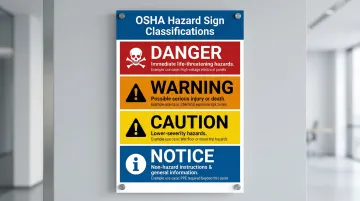
OSHA requires specific color combinations that communicate hazard severity at a glance:
Danger Signs (Red Background, White Lettering)
- Immediate life-threatening hazards
- Examples: High-voltage electrical zones, confined spaces with toxic atmospheres, unguarded floor openings
- Required by 29 CFR 1926.200(b) where immediate hazards exist
Warning Signs (Orange Background, Black Lettering)
- Moderate-risk situations where injury or death is possible but not immediate
- Examples: Open elevator shafts, heavy equipment zones, overhead load paths
- Aligned with ANSI Z535.2 standards
Caution Signs (Yellow Background, Black Lettering)
- Lower-severity hazards requiring safe practices
- Examples: Wet floors, trip hazards, low clearance areas
- Specified in 29 CFR 1926.200(c)
Notice Signs (Blue Background, White Lettering)
- Non-hazard instructions and general information
- Examples: PPE requirements, sanitation rules, visitor check-in procedures
- Governed by ANSI Z535.2 conventions
Design Requirements Under 1910.145
29 CFR 1910.145 establishes specific design rules:
- Use of safety alert symbols (exclamation point in triangle)
- Standardized fonts ensuring readability
- Required signal words (DANGER, WARNING, CAUTION)
- Prohibition of decorative or misleading imagery on safety signs
- Rounded corners and blunt edges to prevent sign-related injuries
Biological Hazard Signs
Beyond standard hazard classifications, 29 CFR 1910.145(e)(4) requires fluorescent orange biohazard signs with the universal biohazard symbol whenever workers may encounter biological or contaminated materials. Common scenarios include:
- Demolition sites containing asbestos
- Renovation projects involving lead paint
- Excavations near septic systems or sewage infrastructure
The Removal Mandate
29 CFR 1926.200(a) requires signs to be "removed or covered promptly when the hazards no longer exist." Leaving outdated warnings in place creates sign blindness: workers grow desensitized to signage over time and begin ignoring even legitimate warnings.
A 1992 OSHA Letter of Interpretation made this concrete — warning tags on completed scaffolds must come down once the structure is confirmed safe. Removal is not optional; it's a compliance requirement with the same weight as posting the sign in the first place.
Types of Signs Required on a Construction Site
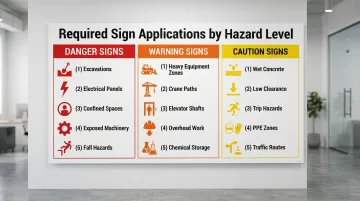
Danger, Warning, and Caution Signs
These core hazard communication signs are mandated by OSHA for specific construction scenarios:
Danger Sign Applications:
- Excavations deeper than 5 feet without proper shoring
- Energized electrical panels and high-voltage equipment
- Confined spaces requiring permits
- Unguarded machinery with exposed moving parts
- Areas with immediate fall hazards exceeding 6 feet
Warning Sign Applications:
- Heavy equipment operating zones
- Crane load paths and swing radius areas
- Open elevator shafts during construction
- Overhead work creating falling object hazards
- Chemical storage areas with moderate toxicity
Caution Sign Applications:
- Freshly poured concrete or wet surfaces
- Low-clearance doorways and passages
- Minor trip hazards and uneven surfaces
- Areas requiring specific PPE (hard hats, safety glasses)
- Temporary construction traffic routes
Admittance and Access Control Signs
Restricted-area signs are required wherever unauthorized entry poses safety risks. 29 CFR 1926.200 mandates clear access control at zone entry points:
- "Authorized Personnel Only" for restricted work areas
- "No Trespassing" for perimeter security
- "Hard Hat Required Beyond This Point" at PPE zones
- "Competent Person Required" for specialized areas like trenches
- "Visitors Must Report to Site Office"
These signs must be posted at every access point to controlled areas, not just main entrances.
Fire Safety and Emergency Signs
29 CFR 1926.34(b) requires exits to be marked by readily visible signs. Specific requirements include:
- Exit Signs: Red letters at least 6 inches high on a white background, with strokes no less than three-fourths inch wide
- Fire Extinguisher Location Signs: Must mark all firefighting equipment conspicuously per 29 CFR 1926.150(a)(3)
- Evacuation Route Markers: Directional arrows guiding workers to emergency exits
- Emergency Assembly Point Signs: Not explicitly required by CFR, but standard practice under emergency action plans (1926.35)
All fire safety signs must remain clearly visible and unobstructed at all times.
Notice and Informational Signs
Blue-background Notice signs communicate non-hazard instructions:
- First aid station locations
- Drinking water and sanitation facilities
- PPE requirements in specific zones
- General safety reminders ("Keep Work Area Clean")
- Site rules and visitor protocols
Directional and Wayfinding Signs
These guide workers and visitors through complex sites, reducing confusion and traffic conflicts:
- Parking area designations
- Site office and superintendent locations
- Material staging and laydown zones
- Equipment access routes
- Emergency exit pathways
RE&D manufactures construction safety signs across all these categories, including custom-printed options for job-specific requirements. Contractors needing compliant signage — from standard OSHA Danger signs to site-specific access control — can order by phone, email, or through RE&D's website.
Sign Placement and Visibility Standards
The 5-Foot Readability Rule
29 CFR 1910.145(f)(4)(ii) explicitly requires that signal words be readable from a minimum distance of 5 feet—or greater as warranted by the hazard. For high-speed equipment zones or large excavations, signs must be readable from significantly farther distances to provide adequate warning time.
Height and Positioning Considerations
Distance requirements only matter if workers can actually see the sign. Place signs at eye level (approximately 5-6 feet from ground level) and position them as close as physically practical to the hazard they reference. 29 CFR 1910.145(f)(4)(vi) requires tags to be "affixed as close as safely possible to their respective hazards."
Placement Guidelines:
- Entry-point placement for access control signs (before workers enter restricted zones)
- Zone-specific placement for hazard warnings (within immediate view of the danger)
- Unobstructed by equipment, materials, or temporary structures
- Multiple signs for large hazard areas to ensure visibility from all approaches
Lighting Requirements for Low-Light Operations
While OSHA doesn't specify dedicated sign illumination standards, 29 CFR 1926.56(a) requires minimum general illumination levels:
- 5 foot-candles for indoor construction areas, corridors, and exitways
- 3 foot-candles for general construction areas and excavation sites
Nighttime operations must ensure signs remain visible through adequate site lighting or reflective/illuminated sign materials. Test visibility under actual site conditions—dust, shadows, and equipment can cut readability far more than open-air testing suggests.
Dynamic Signage Management
Construction hazards shift as projects progress. 29 CFR 1926.200(a) mandates removing or updating signs as site conditions change. An outdated sign telling workers an area is clear when it isn't is a compliance violation—and a liability exposure.
Best Practices:
- Weekly signage audits during active construction phases
- Immediate removal when hazards are abated
- Updated signage when new hazards emerge
- Documentation of sign placement and removal dates
Materials, Durability, and Maintenance of Construction Signs
OSHA's Performance-Based Material Standard
OSHA doesn't mandate specific materials but requires signs to be durable enough to withstand exposure conditions. 29 CFR 1910.145(d)(1) requires signs to have "rounded or blunt corners and shall be free from sharp edges, burrs, splinters, or other sharp projections" to prevent injury.
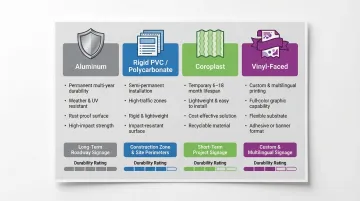
Suitable Material Options
Aluminum:
- Highly resistant to corrosion and UV degradation
- Ideal for permanent installations and multi-year projects
- Withstands extreme temperatures without warping
- Best for outdoor exposure and harsh weather
Rigid PVC/Polycarbonate:
- Impact resistant for high-traffic zones
- Lightweight and easy to mount
- Good chemical resistance
- Suitable for semi-permanent installations
Coroplast (Corrugated Plastic):
- Cost-effective for temporary signage
- Weather resistant for short to medium-term use
- Lightweight and easy to relocate
- Ideal for projects lasting 6-18 months
Vinyl-Faced Substrates:
- Flexible application options
- Excellent for custom graphics and multilingual text
- UV-resistant inks prevent fading
- Laminated coatings protect against abrasion
Weather Resistance Factors
ANSI Z535.2-2023 specifies that signs must be protected from foreseeable visual obstruction and damage, including UV fading, abrasion, and chemical degradation. Industry testing using ASTM G154 and G155 standards simulates years of outdoor exposure to validate durability.
Unprotected signs can fade to illegibility in as little as 6-12 months in direct sunlight. UV-resistant inks, laminated coatings, and rust-proof substrates are essential for outdoor construction signage. Horizontal exposure traps chemicals and accelerates UV damage, which reduces sign durability by up to 50% compared to vertical mounting.
For contractors managing complex or multi-phase projects, RE&D manufactures custom vinyl signs tailored to specific site hazards and environmental conditions, covering the full range of material types described above.
Regular Inspection and Replacement Schedule
Damaged, faded, or illegible signs must be replaced immediately to maintain compliance and effectiveness:
- Weekly visual inspections during routine safety walkthroughs
- Immediate replacement if text is unreadable from 5 feet
- Replacement when colors fade below recognition standards
- Removal when signs become detached or damaged
- Documentation of inspection dates and replacement actions
How to Audit Your Construction Site for Signage Compliance
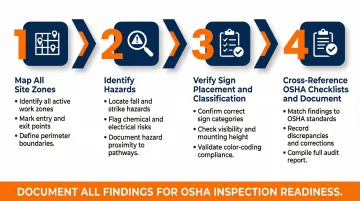
Pre-Audit Walkthrough Process
Step 1: Map All Site Zones
- Identify distinct work areas (excavation, steel erection, electrical, mechanical)
- Document access points and traffic routes
- Note temporary structures and equipment locations
Step 2: Identify Existing and Anticipated Hazards
- Walk through each zone with a competent person
- List all hazards requiring signage under 1926.200
- Identify changing conditions that will require future signage
Step 3: Verify Sign Placement and Classification
- Confirm each hazard has appropriately classified signage (Danger/Warning/Caution)
- Measure readability distance (minimum 5 feet)
- Check for obstructions blocking sign visibility
- Verify signs are placed as close to hazards as practical
Step 4: Cross-Reference Against OSHA Checklists
- Review requirements in 29 CFR 1926.200
- Verify design compliance with 29 CFR 1910.145
- Check State Plan requirements for additional mandates
Documentation for OSHA Inspections
Safety officers and site supervisors should maintain the following records — OSHA inspectors routinely request these, and documented good-faith compliance efforts can reduce proposed penalties under 29 CFR 1903.15:
- Site signage placement map with dates installed
- Hazard assessment documentation justifying sign classifications
- Sign inspection logs with dates and findings
- Replacement records showing prompt corrective action
- Photos documenting signage compliance over project phases
OSHA's Free On-Site Consultation Program
Good recordkeeping gets you inspection-ready, but it won't catch gaps you haven't identified yet. Contractors can get a pre-inspection signage review at no cost through OSHA's On-Site Consultation Program. This program:
- Provides no-cost, confidential occupational safety and health services
- Operates strictly separate from OSHA enforcement—consultants don't issue citations
- Helps identify hazards and recommend corrective actions
- Requires only that employers agree to correct serious hazards within agreed timeframes
Scheduling a consultation before your next project phase starts is one of the lowest-effort steps a site supervisor can take to close compliance gaps before they become recordable incidents.
Frequently Asked Questions
What signs are required on a construction site?
Construction sites are required to post several categories of signs under OSHA standards 29 CFR 1926.200 and 1910.145:
- Danger, Warning, and Caution signs for hazard communication
- Admittance and access control signs for restricted areas
- Fire safety and emergency evacuation signs
- Notice signs for PPE requirements and sanitation rules
- Directional signs for wayfinding throughout the site
What are the OSHA signage requirements for construction?
OSHA mandates specific requirements in 29 CFR 1926.200 and 29 CFR 1910.145, including color codes (red for Danger, orange for Warning, yellow for Caution), standardized signal words, minimum 5-foot readability distance, placement as close to hazards as practical, and prompt removal when hazards no longer exist.
What is mandatory signage?
Mandatory signage refers to signs legally required by OSHA or other regulatory bodies in specific situations. This includes hazard warnings, emergency egress markers, PPE notices at zone entry points, and restricted-area signs. Failure to post required signs can trigger citations and fines.
What happens if a construction site fails to meet OSHA signage requirements?
Non-compliance results in OSHA citations classified as Serious violations (up to $16,550 per violation) or Willful/Repeated violations (up to $165,514 per violation), potential project shutdowns until hazards are corrected, and increased liability in the event of worker injuries where inadequate signage contributed to the incident.
How often should construction site signs be inspected or replaced?
Signs should be inspected during routine safety walkthroughs (minimum weekly during active construction) and replaced immediately if faded, damaged, illegible from 5 feet, or no longer applicable to current site conditions. OSHA requires prompt removal of signs when hazards are abated to prevent worker complacency.
Do construction site signs need to be in multiple languages?
OSHA's signage standards don't explicitly require multilingual signs, but the General Duty Clause under Section 5(a)(1) requires employers to communicate safety information in a language workers understand. Bilingual or multilingual signage is a smart precaution and often necessary on worksites with non-English speaking employees.
Need compliant construction safety signage for your next project? RE&D manufactures and distributes comprehensive safety identification products, including custom construction signs in aluminum, vinyl, and corrugated materials. Contact the team at 1-800-552-3127 or sales@redsafetyids.com to discuss your site-specific requirements and find signage that meets OSHA standards.