Introduction
Construction workers face extraordinary workplace risks: in 2024, the industry recorded 1,032 fatalities, representing 20.35% of all U.S. occupational deaths despite making up a much smaller share of the workforce. That works out to nearly 3 workers killed every single day, making construction one of America's most dangerous professions by any measure.
Many of these tragedies are preventable. The root causes often trace back to inadequate hazard identification systems: unmarked fall hazards, unlabeled chemical containers, unidentified workers in emergency situations, and missing or outdated safety signage. Without reliable identification systems in place, hazards stay hidden until something goes wrong.
This guide provides a practical framework for construction site safety identification: it covers how to recognize and mark physical hazards, implement compliant labeling systems, and establish worker identification protocols that protect lives and satisfy OSHA requirements.
Key Takeaways
- Construction's "Fatal Four" (falls, struck-by, electrocution, caught-in/between) cause 60% of industry deaths—making targeted hazard identification critical
- Safety identification covers two functions: ANSI-compliant hazard signage and personnel ID through badges and hard hat tags
- Hazard Communication violations totaled 2,546 citations in FY2025, making proper labeling both a compliance and safety imperative
- On multi-contractor sites, visible worker ID systems close accountability gaps and speed emergency response
- Daily inspections, standardized signage, PPE marking, and worker ID define the baseline for compliant job sites
What Is Construction Site Safety Identification?
Construction site safety identification has two distinct jobs: marking the hazards workers face and confirming that every person on site belongs there.
Hazard Labeling and Communication
The first pillar involves marking dangerous areas, equipment, and materials so workers immediately understand the risk. This isn't simply posting a generic warning sign—it requires a comprehensive visual communication system using signs, labels, tags, color-coded barrier tape, and floor markings that meet OSHA 1926.200 and ANSI Z535 standards. Non-compliant or improvised signage fails both legal audits and the fundamental goal of clear hazard communication.
Personnel Identification and Accountability
The second pillar ensures every worker on site is known, authorized, and reachable in an emergency. Construction sites constantly rotate contractors, subcontractors, and specialty trades who may not know each other. From a distance, standardized PPE makes everyone look identical, creating serious risks around unauthorized presence, accountability gaps, and emergency misidentification.
The sections below break down exactly how to implement both systems—from compliant signage selection to worker badging and access control.
Recognizing the Most Common Construction Site Hazards
Effective hazard identification starts with understanding which dangers pose the greatest threat to worker safety.
OSHA's Fatal Four Hazards
OSHA's "Fatal Four" account for approximately 60% of construction worker deaths each year. These four categories represent the most lethal hazards on construction sites:
- Falls - The leading cause of construction deaths, including 421 fatal falls to a lower level in 2023. Unguarded edges, unprotected holes, unstable scaffolding, and inadequate ladder safety drive these fatalities
- Struck-by incidents - Forcible contact with vehicles, falling objects, swinging crane loads, or rolling equipment causes hundreds of deaths annually
- Electrocutions - Contact with overhead power lines, energized electrical sources, or faulty extension cords kills workers who lack proper clearance markers and lockout procedures
- Caught-in/between hazards - Workers crushed by trench cave-ins, rotating equipment, or collapsing structures face catastrophic injuries when equipment guarding and excavation protections fail
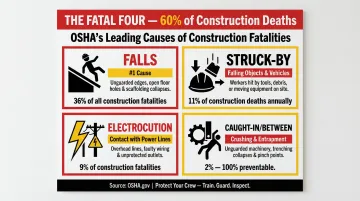
These categories demand the highest priority in your signage budget and hazard marking strategy. Fall protection and struck-by prevention should dominate your visual identification system — anything less leaves your highest-risk exposures undermarked.
Identifying Chemical and Ergonomic Hazards
Chemical Exposures
Construction workers encounter hazardous substances that require both Safety Data Sheet (SDS) documentation under OSHA's Hazard Communication Standard (1910.1200) and physical container labeling. According to OSHA's 2024 occupational chemical exposure data, the most frequently sampled substances in construction include:
- Silica (quartz) - 18.8% of samples
- Carbon monoxide - 9.1% of samples
- Inorganic lead - 6.2% of samples
Additional chemical hazards include asbestos, welding fumes, solvents, and adhesives. Each requires GHS-compliant labeling with pictograms, signal words, and hazard statements on containers and work zone signage.
Ergonomic Hazards
Ergonomic risks cause significant long-term harm — construction workers experienced 33,200 days-away-from-work cases due to musculoskeletal disorders from 2021-2022. Repetitive motion, heavy lifting, awkward postures, and vibration exposure should be flagged through job safety analyses (JSAs), with awareness signage posted in the specific work areas where those tasks occur.
How to Conduct a Hazard Identification Walk-Through
Pre-Shift Inspection Process
Walk the entire site before each shift begins, checking for new or changed conditions using a standardized checklist that verifies:
- Equipment guarding status and machinery condition
- Electrical hazard exposure and proper clearances
- Fall protection systems and edge guarding
- Chemical storage compliance and container labeling
- Excavation protections and trench safety
These daily checks serve as the first line of defense, identifying hazards before workers are exposed.
Ongoing Hazard Monitoring
Pre-shift inspections only capture the starting state — construction site conditions shift constantly as work progresses. Supervisors must be trained to spot and report emerging risks throughout the day, not just during formal inspections. Re-inspection frequency should match the pace of work—high-activity phases demand more frequent hazard reviews than slower periods.
Safety Identification Tools Every Job Site Needs
Effective hazard communication depends on three categories of tools: standardized signs, physical barriers, and equipment labeling. Each serves a distinct function — and each has specific compliance requirements that can't be swapped or skipped.
Standardized Safety Signs and ANSI Z535 Classifications
ANSI Z535 standards establish a uniform system for safety sign design and use. Understanding these classifications is critical because using the wrong sign category represents both a compliance failure and a communication breakdown:
| Signal Word | Color Code | Use Condition |
|---|---|---|
| DANGER | Red background, white text | Immediate life-threatening hazard that WILL cause death or serious injury if not avoided |
| WARNING | Orange background, black text | Potentially life-threatening hazard that COULD cause death or serious injury |
| CAUTION | Yellow background, black text | Minor to moderate injury risk if not avoided |
| NOTICE | Blue background, white text | Non-injury information (property damage, procedures, security) |
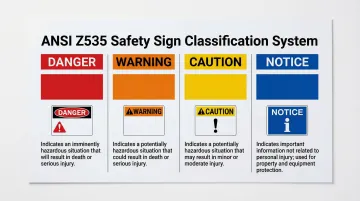
OSHA legally enforces these standards through 29 CFR 1926.200, which incorporates ANSI specifications by reference. A critical requirement: signs must be visible at all times during work and removed promptly when hazards no longer exist. Leaving obsolete signage creates worker complacency and "sign blindness."
Color-Coded Barriers and Floor Markings
Physical delineation of hazard zones uses standardized color codes that reduce confusion and speed recognition, especially for large crews and non-English-speaking workers:
- Red - Danger zones and fire protection equipment
- Yellow - Caution areas and physical hazards
- Orange - Construction equipment zones and temporary traffic control
Consistent color application across your site creates an intuitive visual language that workers can process instantly, even from a distance.
Labeling Hazardous Materials and Equipment
Chemical Container Requirements
Hazard Communication ranked second among all OSHA violations in FY2025 with 2,546 citations. Mislabeled or unlabeled containers represent one of the most frequently cited violations in construction.
GHS-compliant labels must include:
- Product identifier matching the SDS
- Signal word (Danger or Warning)
- Pictograms (black symbols on white background with red frame)
- Hazard statements describing the threat
- Precautionary statements specifying required PPE
- Manufacturer identification and contact information
Equipment Identification and LOTO
Equipment-specific identification prevents workers from operating unsafe machinery:
- Tag out-of-service or defective tools with lockout/tagout (LOTO) tags
- Use visible equipment condition labels showing inspection dates
- Mark load capacities on lifting equipment and scaffolding
- Apply equipment-specific operating instructions
While OSHA's general industry LOTO standard (1910.147) excludes construction, construction sites must still comply with 29 CFR 1926.417 for tagging of circuits. Proper energy control prevents an estimated 120 fatalities and 50,000 injuries annually across all sectors.
Sourcing compliant products for each of these requirements is where many sites cut corners. RE&D (Rodgers Enterprises and Distributors Inc.) manufactures ANSI-compliant safety signs in aluminum, plastic, vinyl, and corrugated materials, alongside lockout tags, hard hat decals, and custom identification solutions for site-specific needs. Founded in 1992 and based in Grove City, PA, RE&D also produces custom-manufactured products for sites with specialized marking requirements.
Worker Identification and Job Site Access Control
Physical hazard marking alone doesn't create a safe job site—knowing who is present and authorized is equally critical.
The Construction Site Identity Challenge
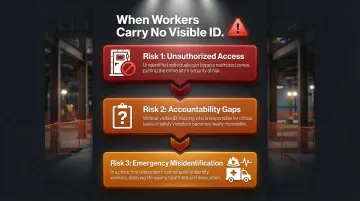
Construction sites constantly rotate contractors, subcontractors, and specialty trades who may not know each other. Standardized PPE makes everyone look identical from a distance, creating three serious risks:
- Unauthorized individuals can enter restricted areas undetected when workers carry no visible ID
- Incident investigations stall when there's no record of who was present, what work they performed, or which employer is responsible
- First responders lose critical time when an injured worker carries no identity, employer, or medical information on their person
Functional Worker ID Systems
Effective worker identification requires visible, durable solutions attached to required PPE:
Effective badges and hard hat tags should display:
- Worker's full name
- Employer/contractor name
- Trade or specialty
- Authorization level or clearance
- Emergency contact information (optional but recommended)
Hard hat-mounted ID solutions prove more reliable than lanyards or card systems that get lost, covered by clothing, or removed during work. RE&D manufactures hard hat decals and custom identification products built to hold up to the grime, heat, and physical contact of active job sites.
Managing Contractor and Subcontractor Accountability
Site Access Control Systems
Implement structured entry protocols including:
- Sign-in/sign-out logs at all access points
- Credential verification before site entry
- Digital badging systems for larger projects
- Contractor orientation records documenting safety briefings
OSHA auditors expect site managers to account for every person on site. Paper-based systems often fall short during real-time emergencies when accurate headcounts are critical — a gap that proper access control and ID systems help close.
Multi-Employer Citation Liability
Under OSHA's Multi-Employer Citation Policy (CPL 02-00-124), "controlling" general contractors can be cited for hazards created by subcontractors if they fail to exercise reasonable care. Visible worker identification, documented orientations, and strict access control establish a verifiable chain of accountability that demonstrates reasonable oversight.
Common Safety Identification Mistakes to Avoid
Safety programs with strong intentions still break down in predictable ways. Three mistakes show up on job sites repeatedly — and each one puts workers at real risk.
The "Set It and Forget It" Mistake
Posting signs or labels at project start and never updating them as conditions change creates a dangerous false sense of security. OSHA requires signs to be removed or covered promptly when hazards no longer exist. Signs that no longer reflect current conditions mislead workers rather than protecting them.
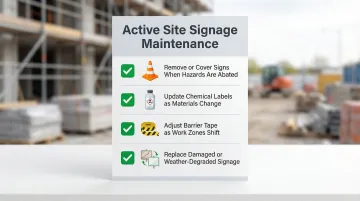
Active construction sites require ongoing signage updates:
- Remove or cover signs when hazards are abated
- Update chemical inventories and labels as materials change
- Adjust barrier tape and floor markings as work zones shift
- Replace damaged or weather-degraded signage immediately
Using Non-Compliant or Improvised Signage
Hand-written warning notes, incorrect color codes, or signs that don't meet ANSI Z535 or OSHA HazCom standards fail in two ways. Non-compliant signage triggers OSHA citations during inspections. It also creates a communication breakdown: workers trained on standardized colors, signal words, and pictograms can't reliably interpret improvised warnings. For workers with limited English proficiency — who depend on those symbols most — this gap is especially dangerous.
The Worker Identification Gap
Assuming that orientation briefings eliminate the need for ongoing visible identification ignores three realities:
- Worker turnover - New workers join projects mid-stream without knowing existing crews
- Multi-site rotation - Contractors working multiple projects may not be familiar to all supervisors
- Language barriers - Visual ID systems work across language differences that verbal identification cannot overcome
Treat worker identification as a permanent feature of site management — one that stays active from groundbreaking through project closeout.
Frequently Asked Questions
What is construction site safety identification?
Construction site safety identification refers to the integrated system of tools, practices, and protocols used to visually communicate hazards (through ANSI-compliant signs, labels, and color coding) and identify all personnel present (through ID badges, hard hat tags, and access control systems). This dual approach ensures both hazards and people are properly identified and managed.
What are the three types of hazards identified in Section 2 of the Safety Data Sheet (SDS)?
Section 2 of an SDS identifies physical hazards (flammability, reactivity), health hazards (carcinogenicity, toxicity), and provides hazard classification information. Environmental hazards appear in the non-mandatory Section 12. Construction sites must maintain readily accessible SDS sheets for all hazardous chemicals under OSHA's HazCom Standard.
What are the four C's of safety culture in construction?
The four C's of safety culture are Control, Communication, Co-operation, and Competence. Together, these principles guide how construction firms embed safety identification into daily operations—from who owns hazard decisions to whether workers have the skills to act on them.
What are the most common hazards on a construction site?
OSHA's Fatal Four—falls, struck-by incidents, electrocution, and caught-in/between hazards—account for approximately 60% of construction fatalities. Chemical exposures (particularly silica dust, lead, and carbon monoxide) and ergonomic hazards causing musculoskeletal disorders also contribute to worker injuries and long-term health problems.
How often should construction site safety inspections be conducted?
OSHA recommends regular site inspections, with industry best practice calling for daily pre-shift walk-throughs and formal weekly or project-phase audits. Inspection frequency should increase when site conditions, work phases, or crew composition change significantly.
Protecting workers requires visibility—both of hazards and of the people exposed to them. Construction site safety identification is the visual communication system that keeps workers alive—nearly three die on job sites every day in America.
For comprehensive safety identification solutions designed specifically for construction site conditions, contact RE&D at 1-800-552-3127 or sales@redsafetyids.com to discuss standard and custom products that meet ANSI and OSHA requirements.