Introduction
A facility manager in Ohio walks the production floor minutes before an OSHA inspector arrives, only to discover that half the equipment nameplates lack required voltage ratings and the forklift capacity plate has faded to illegibility. The resulting citation carries a $16,550 penalty—and that's just for one serious violation. In manufacturing and construction environments, equipment labels aren't administrative formalities; they're legal requirements tied directly to workplace safety, regulatory compliance, and financial liability.
That penalty reflects a broader reality: multiple overlapping standards govern equipment labels across industries. OSHA mandates content and legibility under 29 CFR 1910.145 and 1910.1200, ANSI Z535 dictates design language and color coding, and certification bodies like UL, CSA, and ISO each impose their own marking requirements.
Missing any single standard can mean six-figure fines, halted production during inspections, or liability exposure when inadequate labeling contributes to a workplace injury. This guide breaks down what must appear on equipment labels, which regulatory frameworks apply to your industry, and how to maintain compliance throughout equipment lifecycles.
Key Takeaways
- Equipment labels must include manufacturer details, model/serial numbers, operational ratings, and safety warnings; required elements vary by industry and regulatory body
- OSHA enforces labeling under 29 CFR 1910.145 for accident prevention signs and 1910.1200 for HazCom chemical labels
- ANSI Z535 standardizes safety label design through signal word hierarchy, color schemes, and pictogram layouts
- UL, CSA, and ISO certifications each require specific marks and testing for product safety and international trade
- Non-compliance risks OSHA fines up to $165,514 per willful violation, failed inspections, and significant liability exposure
What Must Be Included on an Equipment Label
Every equipment label serves two functions: identification and hazard communication. Regulatory frameworks converge on four foundational data categories that must appear on most industrial equipment.
Core Identification Data:
- Manufacturer name and contact information (address, phone number)
- Equipment model designation and unique serial number
- Date of manufacture or commissioning
- Capacity ratings (load limits, working pressure, flow rates)
Operational and Electrical Specifications:
Equipment type determines which performance data must appear. Industrial machinery requires voltage, amperage, phase count, and frequency under NFPA 79 standards. Pressure vessels display maximum allowable working pressure (MAWP) and minimum design metal temperature (MDMT) per ASME requirements. Forklifts show weight, maximum capacity, and compliance with ANSI B56.1.
Specificity matters here. Listing "480V" without phase count or frequency leaves a label incomplete under electrical safety standards — a gap that can result in a citation during an OSHA inspection.
Safety Warning Content:
OSHA's Hazard Communication Standard (29 CFR 1910.1200) and ANSI Z535 both define what a compliant warning must include:
- Hazard nature — what the danger actually is
- Signal word — DANGER, WARNING, or CAUTION to indicate severity
- Consequence — what happens if the hazard is ignored ("can cause death or serious injury")
- Required action — specific steps to avoid harm ("disconnect power before servicing")
A label that only states "High Voltage" satisfies none of these requirements on its own.
Traceability Elements:
Serial numbers enable asset tracking, but specialized equipment demands more. Medical devices require FDA Unique Device Identifiers (UDIs) — each combining a Device Identifier (DI) and Production Identifier (PI). Barcodes facilitate inventory management. These elements support regulatory traceability during recalls, audits, and incident investigations.
Material Durability Requirements:
A label that meets all content requirements but fades within six months is considered non-compliant. OSHA mandates that labels remain legible throughout equipment life under operating conditions—chemical exposure, UV radiation, heat, abrasion. UL 969 and CSA C22.2 No. 0.15 establish durability testing protocols that evaluate adhesive-attached labels through water immersion, elevated temperatures, and chemical exposure. Choosing the wrong substrate — polyester where vinyl was required, for instance — can mean reprinting an entire asset fleet after an audit finding.
OSHA Labeling Requirements for Equipment
OSHA sets and enforces equipment labeling requirements across dozens of industry-specific regulations. Equipment labeling violations appear consistently in the agency's Top 10 most frequently cited standards — making compliance a practical priority for any manufacturing or construction operation.
Accident Prevention Signs and Tags (29 CFR 1910.145)
This standard governs the design requirements for safety signs on equipment, establishing color coding and classification systems:
Sign Classifications:
- Danger signs: Immediate hazard requiring special precautions (red, black, white color scheme)
- Caution signs: Potential hazards or unsafe practices (yellow background with black panel)
- Safety instruction signs: General safety measures (white background with green panel)
OSHA incorporates ANSI Z53.1-1967 and ANSI Z535.1-2006 by reference for color standards, making these color specifications legally enforceable.
Hazard Communication Standard (29 CFR 1910.1200)
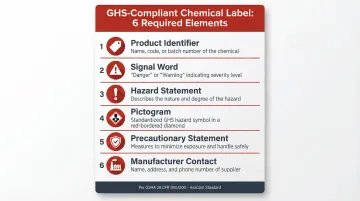
HazCom governs labeling of hazardous chemicals on and around equipment. Under the GHS-aligned standard updated in 2024, shipped containers must display six elements:
- Product identifier – Chemical name matching the Safety Data Sheet
- Signal word – "Danger" or "Warning" indicating severity
- Hazard statement(s) – Nature of the hazard (e.g., "Causes skin irritation")
- Pictogram(s) – Standardized GHS symbols in red diamond borders
- Precautionary statement(s) – How to prevent exposure
- Manufacturer contact information – Name, U.S. address, and telephone number
Employers must update chemical labels within six months of learning new significant hazard information. Workplace labels may use alternative methods—signs, placards, process sheets—provided they convey required information and remain readily accessible. Portable containers for immediate use by a single employee are exempt from labeling requirements.
Forklift and Powered Industrial Truck Nameplates
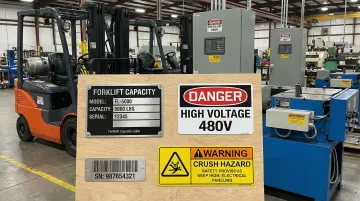
OSHA 29 CFR 1910.178 mandates that powered industrial trucks display a durable, corrosion-resistant nameplate approved by a Nationally Recognized Testing Laboratory (NRTL). Required data includes:
- Model designation and serial number
- Truck weight and maximum capacity
- Compliance with ANSI B56.1 design standards
Users must maintain nameplate legibility. Faded or missing plates require immediate replacement. Modifications affecting capacity demand manufacturer approval and corresponding nameplate updates.
Employer Maintenance Responsibilities and Financial Stakes
OSHA prohibits employers from removing or defacing existing labels on incoming containers. Workplace labels must remain legible, in English, and prominently displayed throughout equipment life. Failing to meet these obligations carries real financial consequences. As of January 2025, OSHA penalty caps are:
- Serious violations: $16,550 per violation
- Willful or repeated violations: $165,514 per violation
- Failure to abate: $16,550 per day beyond the abatement date
Two enforcement cases show how quickly penalties accumulate. In 2021, JBS Foods received a $6,436 penalty when secondary containers in a flammable cabinet lacked chemical identification and hazard warnings. Alfa Laval was cited in 2015 for using spray bottles containing penetrating oil and cutting lubricant without any labels identifying the chemicals.
Understanding ANSI Z535 Safety Label Standards
ANSI Z535 provides the design language for safety labels on products and equipment throughout U.S. manufacturing and construction. Developed by the American National Standards Institute, it's technically voluntary — but OSHA references it extensively, making it the practical industry standard.
Signal Word Hierarchy (ANSI Z535.4)
The standard establishes three primary signal words with corresponding colors and severity levels:
| Signal Word | Color Scheme | Hazard Level | Consequence |
|---|---|---|---|
| DANGER | Safety white letters on safety red background | Immediate hazard | Death or serious injury will result |
| WARNING | Safety black triangle with safety orange exclamation mark | Potential hazard | Death or serious injury could result |
| CAUTION | Safety black letters on safety yellow background | Moderate risk | Minor or moderate injury could result |
| NOTICE | Italicized safety white letters on safety blue background | Non-injury practices | Property damage or operational issues |
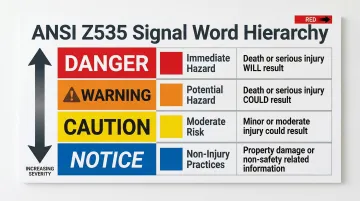
The hierarchy isn't interchangeable. Mislabeling a high-voltage panel as "Caution" instead of "Danger" understates risk and creates liability exposure.
Required Label Elements
An ANSI-compliant safety label contains four components in standardized layout:
- Signal word header panel sized and colored to match the severity level
- Pictogram using black symbols on a color background to depict the specific hazard
- Hazard description stating what the danger is and its probable consequence
- Avoidance message explaining how to prevent injury
The layout and color system ensure recognition across workplaces regardless of literacy level or language proficiency — which matters more once international markets enter the picture.
ANSI Z535 vs. ISO 7010 Safety Symbols
Facilities serving international markets face a specific design challenge: ANSI relies heavily on text-based signal word panels, while ISO 7010 emphasizes universal graphical symbols. ISO prescribes registered safety signs for accident prevention, fire protection, and emergency evacuation without requiring English text. ISO 3864-1 establishes safety identification colors and design principles that differ slightly from ANSI conventions.
Companies exporting equipment or operating multinational facilities typically create dual-compliant labels — combining ANSI signal word panels with ISO pictograms to satisfy both frameworks.
UL, CSA, and ISO Certification Standards
Certification marks on equipment nameplates aren't decorative—they represent third-party testing and impose strict controls on who can print them.
UL Certification and Mark Authorization
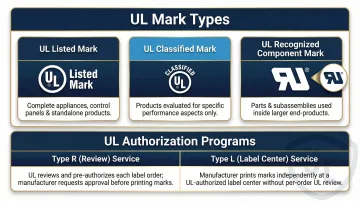
The UL Mark indicates a product met relevant safety standards during testing. Three mark types apply to different product categories:
- UL Listed: Complete, standalone products (appliances, control panels) suitable for installation
- UL Classified: Products evaluated for specific performance aspects or regulatory codes
- UL Recognized Component: Parts or subassemblies intended for factory installation in larger systems (features backward "RU" mark)
Only UL-authorized manufacturers can print UL marks. Unauthorized marks trigger fines or market removal. Two authorization programs control printing:
| Program | How It Works |
|---|---|
| Type R (Review) Service | Manufacturers submit proposed mark layouts for UL authorization. Once approved, the manufacturer or their supplier prints labels with a 4-character alphanumeric control number. |
| Type L (Label Center) Service | Each order requires specific written authorization from a UL Label Center (PGAA), specifying the supplier, exact quantity, and serial numbers. Labels must be sourced from an Authorized Label Supplier—customers cannot print independently. |
CSA Standards
A CSA mark confirms a product meets safety and performance requirements for U.S. and Canadian markets. OSHA and ANSI recognize CSA marks; certain regulated product categories require them for workplace compliance. CSA C22.2 No. 0.15 establishes adhesive label durability requirements, covering permanent labels for indoor and outdoor use. The standard evaluates legibility and adhesion under environmental conditioning similar to UL 969.
CSA Group Testing and Certification Inc. operates as an officially recognized NRTL, giving CSA-marked products acceptance in OSHA-regulated workplaces.
ISO Standards for Equipment Identification
Where UL and CSA govern North American markets, ISO standards set international requirements for safety communication and product traceability:
- ISO 7010 defines standardized safety symbols (prohibition, warning, rescue, fire safety) using graphical language instead of text-dependent formats
- ISO 3864-1 specifies design principles for safety signs, including color contrast ratios and symbol sizing for visibility
- ISO 9001 Clause 8.5.2 requires quality management systems to maintain product identification and traceability through unique identifiers, model numbers, and manufacturer details on nameplates
Industry-Specific Equipment Label Requirements
Labeling rules vary significantly by industry — and in high-stakes sectors, the specifics are tightly regulated.
Manufacturing and Construction
NFPA 79 (Industrial Machinery): Chapter 16 mandates electrical nameplates on control equipment. Required data includes:
- Manufacturer name or trademark
- Serial number
- Rated voltage, phases, and frequency
- Full-load current
- Ampere rating of the largest motor or load
OSHA 1910.179 (Cranes): Rated load must be plainly marked on each side of the crane, legible from the ground or floor. Multi-hoist cranes require rated load marked on each hoist or load block.
Medical Devices
FDA UDI (21 CFR Part 801): Medical equipment requires a Unique Device Identifier combining a Device Identifier (DI) and Production Identifier (PI). The UDI must appear in both plain-text and AIDC (barcode) formats. Reusable devices intended for reprocessing require permanent direct part marking with the UDI.
Boilers and Pressure Vessels
ASME BPVC Section VIII: Vessels must bear a metal nameplate (minimum 0.020 in. thick) featuring the ASME Certification Mark (Code Symbol Stamp). Required data includes manufacturer name, MAWP, MDMT, and serial number.
Approved attachment methods are limited to:
- Welding or brazing
- Tamper-resistant mechanical fasteners
- Approved pressure-sensitive adhesives
Aviation Components
FAA 14 CFR Part 45: Aircraft and engines require fireproof identification plates secured to prevent loss in accidents. Required data includes builder name, model designation, and serial number.
Military Applications
MIL-DTL-15024: Classifies nameplate types by material — chemically etched, mechanically engraved, stamped, and foil/vinyl/polyester variants. Specifies colors, finishes, marking methods, and fungus resistance for defense contractor applications.
Why Equipment Label Compliance Matters
Non-compliance creates operational and financial consequences that extend far beyond the label itself.
Regulatory and Financial Risks
Failed OSHA inspections trigger citations that escalate quickly. A serious violation for missing hazard communication labels costs $16,550. If the violation is deemed willful—the employer knew the requirement and ignored it—the penalty jumps to $165,514. Failure to abate adds $16,550 per day until corrected. Multiple violations across a facility compound rapidly.
Product launch delays occur when certification bodies identify non-compliant markings during final inspections. Equipment already in service may require recall and re-labeling, multiplying costs through logistics, downtime, and reputational damage.
Inadequate labels also create direct legal liability. If an operator suffers electrical shock because a panel lacked voltage warnings, that missing label becomes evidence of negligence in litigation.
Operational and Safety Benefits
Compliant labels do more than satisfy auditors — they protect people and keep operations running. Key benefits include:
- Forklift capacity plates prevent tipping accidents by communicating safe working loads
- Electrical nameplates identify voltage and phase before maintenance, reducing shock and arc flash risk
- Serial numbers link equipment to service records, calibration schedules, and warranty status
- Barcodes speed up inventory management and cut downtime through faster asset identification
Navigating which label format, material, and marking meets each specific standard adds another layer of complexity. RE&D has worked with manufacturing and construction operations for over 33 years, helping teams select the right identification products for their regulatory requirements. Their technical team is reachable at 1-800-552-3127.
Frequently Asked Questions
What does OSHA require on labels?
OSHA requirements vary by standard. 29 CFR 1910.145 governs accident prevention signs, mandating specific color coding and classifications (Danger, Caution, Safety Instruction). 29 CFR 1910.1200 (HazCom) covers hazardous chemical labels, requiring signal words, pictograms, hazard and precautionary statements, product identifier, and manufacturer contact information.
What must be included on an equipment label?
Core elements include manufacturer name and contact, model and serial number, operational ratings (voltage, capacity, pressure), safety warnings with signal words, and applicable certification marks (UL, CSA, ASME, NRTL). Specific requirements vary by equipment type and industry.
What is the ANSI Z535 standard?
ANSI Z535 is the U.S. standard for safety labels and signs. It defines signal word hierarchy (Danger = death/serious injury will result; Warning = could result; Caution = minor/moderate injury could result), required colors (red, orange, yellow), pictogram use, and label layout. Manufacturing and construction sectors rely on it for consistent hazard communication.
What is the difference between UL Listed and UL Recognized?
UL Listed applies to complete, standalone products like appliances and control panels that are ready for installation. UL Recognized applies to components intended for factory installation within a larger system or assembly. Both require product testing, but carry different marks and certification scope.
What happens if equipment labels don't meet compliance standards?
Non-compliance triggers OSHA citations with penalties from $16,550 (serious violations) to $165,514 (willful violations), and equipment may face failed inspections, market removal, or costly recalls. Inadequate labeling also increases liability exposure when a workplace injury occurs.
Do equipment labels need to be updated or replaced over time?
Yes. OSHA requires labels to remain legible throughout equipment life—employers must replace defaced, faded, or missing labels immediately. Chemical labels must be updated within six months if new significant hazard information becomes known. Regular inspections should verify nameplate legibility and replace damaged labels before they trigger citations.