Introduction
A plant manager walks the floor and spots a chemical drum with a faded, illegible label. The contents are unknown, the hazard warnings unreadable. Nearby, a maintenance technician hesitates before opening an unmarked valve—is it water, steam, or something corrosive? At the loading dock, a shipment is rejected because the pallet labels don't meet regulatory standards. These aren't edge cases. In facilities where labeling is inconsistent or degraded, incidents like these happen routinely.
Industrial labeling covers the labels applied to materials, equipment, products, pallets, and containers across manufacturing and logistics environments. They communicate safety information, enable asset tracking, and support compliance with regulations that carry serious financial and legal consequences.
This guide covers the core topics: types of industrial labels, key applications, how to match materials to harsh environments, compliance requirements, and best practices for building a reliable labeling system.
TLDR:
- Industrial labels serve critical functions: asset tracking, hazard communication, compliance, and supply chain accuracy
- Label material (vinyl, polyester, metal) must match the environment to prevent peeling, fading, or illegibility
- OSHA violations for improper labeling can reach $165,514 per willful or repeated offense
- Thermal transfer printing is the industry standard for durable labels that resist chemicals, heat, and UV exposure
- Custom labels typically outperform generic retrofits in specialized industrial applications
What Is Industrial Labeling and Why It Matters
Industrial labeling is the creation and application of durable, machine-readable, or visually communicative labels designed specifically for industrial environments. Unlike consumer labels where aesthetics matter, industrial labels prioritize performance, legibility, and longevity under harsh conditions.
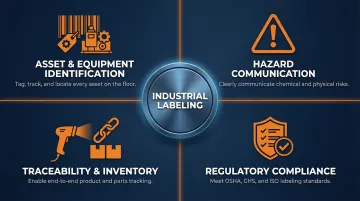
These labels serve four core functions that are operationally critical:
- Identifying equipment and assets through serial numbers, barcodes, or RFID tags that enable lifecycle tracking
- Communicating hazards and safety instructions via color-coded warnings, pictograms, and signal words
- Enabling traceability through scannable codes that support inventory management and supply chain visibility
- Supporting regulatory compliance with OSHA, ANSI, ASME, and industry-specific standards
When these functions break down, the consequences show up quickly in compliance records and operational costs. OSHA's Hazard Communication standard was the second most frequently cited violation in 2024, resulting in 2,888 citations. On the operational side, the Auburn University RFID Lab found that supply chains relying on legacy barcode processes experienced errors in 69% of inbound orders, leading to costly chargebacks and rework. Upgrading to RFID-based labeling allowed those same organizations to achieve 99.9% order accuracy.
Types of Industrial Labels
Not all industrial labels serve the same purpose. The right type depends on the environment, the information being communicated, and how the label will be read or scanned.
Adhesive and Pressure-Sensitive Labels
Adhesive labels are the most common type, suitable for a wide range of surfaces including metal, plastic, glass, and cardboard. They're available with specialized adhesives engineered for moisture, heat, or chemical exposure. Typical applications include:
- Inventory management and stock control
- Product identification and branding
- Logistics and shipping documentation
- General equipment marking
These labels work well when environmental conditions are moderate and the surface is clean and dry at application.
Safety and Warning Labels
Safety labels are purpose-built for hazard communication and must follow strict design standards. Key types include:
- GHS chemical labels for hazardous substance containers
- Equipment warning labels for machinery hazards
- Lockout/tagout (LOTO) labels for maintenance safety procedures
OSHA's HazCom standard requires specific label elements: product identifier, signal word (Danger or Warning), hazard statements, pictograms (black symbol on white background within red diamond), precautionary statements, and manufacturer contact information. The ANSI Z535 series provides the design blueprint for safety signs and labels, establishing color codes, signal words, and formatting rules that improve worker hazard recognition.
RE&D has manufactured and distributed safety identification products since 1992, supplying manufacturing and construction operations with LOTO tags, custom safety signs in multiple materials, and equipment warning labels built for harsh conditions.
RFID and Barcode Labels
The choice between barcodes and RFID dictates operational throughput and accuracy:
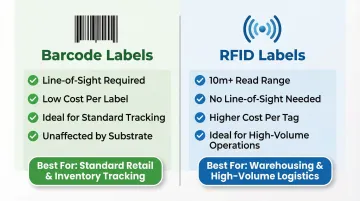
Barcode Labels:
- Require close proximity and line-of-sight scanning
- Very low cost per label
- Ideal for most tracking needs
- Unaffected by substrate material
RFID Labels (UHF Passive):
- Read at distances exceeding 10 meters without line of sight
- Capture unique identifiers at extremely high rates simultaneously
- Higher cost per tag
- Better for high-volume operations or metal packaging environments (with specialized mount-on-metal tags)
Barcodes remain the cost-effective default for most operations. Facilities dealing with picking errors or workflow bottlenecks should evaluate RFID to automate data capture and remove the need for line-of-sight scanning.
Durable Specialty Labels
When standard adhesive labels fail, specialty labels become necessary:
- Metal labels (stainless steel, aluminum) for extreme heat, corrosive chemicals, or permanent asset identification that must last decades
- In-mould labels fused into plastic during manufacturing for reusable containers
- Tamper-evident labels that show visible damage when removal is attempted, protecting against unauthorized access
These materials cost more but deliver far longer lifespans in environments where polymer labels degrade within months.
Key Applications of Industrial Labels
Industrial labels serve distinct functions across operations—from tracking equipment lifecycles to satisfying federal compliance requirements. Each application demands different materials, formats, and standards.
Asset and Equipment Identification
Asset labels with serial numbers, barcodes, or RFID enable facilities to track tools, machinery, and equipment through their entire lifecycle. This supports:
- Maintenance scheduling based on usage hours or calendar intervals
- Equipment audits and inventory reconciliation
- Loss prevention in large facilities where tools move between departments
- Warranty and service history documentation
Durable name plates—manufactured from stainless steel, aluminum, or phenolic materials—provide permanent identification for equipment in harsh environments where adhesive labels would fail.
Inventory and Supply Chain Management
Barcode and RFID labels enable real-time inventory tracking from receiving through shipping. Benefits include:
- Reduced picking errors through scan verification
- Improved stock accuracy and cycle count efficiency
- Warehouse management system (WMS) integration for automated data capture
- Faster processing at receiving and shipping docks
The Auburn University study demonstrated that RFID implementation reduced inbound order errors from 69% to near-zero, eliminating costly chargebacks and rework.
Safety Compliance and Hazard Communication
Safety labels on chemical containers, machines, electrical panels, and walkways communicate critical risk information to workers. OSHA's HazCom standard (29 CFR 1910.1200) creates a legal obligation to maintain legible, up-to-date safety labels on equipment and hazardous materials.
ANSI Z535 standards dictate the design requirements:
- ANSI Z535.1 establishes safety color standards and tolerances
- ANSI Z535.2 regulates facility safety signs and header classifications (Danger, Warning, Caution, Notice)
- ANSI Z535.4 dictates product safety label specifications
- ANSI Z535.5 covers safety tags and lockout/tagout procedures
Standardizing your facility's visual communication using these formatting rules ensures compliance and improves worker hazard recognition.
Pipe and Facility Identification
Pipe marking is a specialized industrial labeling application governed by ASME A13.1 (Scheme for the Identification of Piping Systems). The standard requires:
- Color coding by hazard category (flammable, toxic/corrosive, firefighting)
- Legend text identifying exact contents, temperature, or pressure
- Directional flow arrows indicating fluid direction
- Proper placement for clear viewing from normal approach
While OSHA doesn't have a standalone pipe marking regulation for general industry, it explicitly references ASME A13.1 as recognized good engineering practice. OSHA citation abatement notes frequently instruct employers to ensure valve labeling per ASME A13.1.
Facilities that skip consistent pipe and valve identification face real consequences: OSHA inspectors routinely cite employers under general duty clause violations when piping systems lack adequate labels, even without a specific pipe marking regulation.
How to Choose the Right Industrial Label Material
The wrong label material in the wrong environment leads to peeling, fading, or illegibility—creating safety risks and compliance failures. The goal is to match substrate, adhesive, and print method to the actual conditions the label will face.
Assess the Environmental Conditions First
Before selecting a material, evaluate these key factors:
- Temperature range: Ambient indoor vs. extreme heat or freezing conditions
- Chemical or solvent exposure: Oils, fuels, cleaning agents, or corrosive substances
- Moisture and washdown frequency: Wet environments or high-pressure cleaning
- UV or outdoor exposure: Direct sunlight causing fading
- Surface texture: Smooth metal vs. rough concrete vs. curved plastic
Common Label Materials and Their Best-Fit Environments
| Material | Temperature Rating | Best Applications |
|---|---|---|
| Vinyl (PVC) | Moderate temperatures | General-purpose indoor/outdoor use, pipe marking, curved surfaces |
| Polyester (PET) | -40°F to 300°F (-40°C to 149°C) | Equipment labels, asset tracking, chemical-resistant applications |
| Polyimide (Kapton) | 428°F–464°F continuous; up to 752°F short-term | Electronics manufacturing, high-heat environments, aerospace |
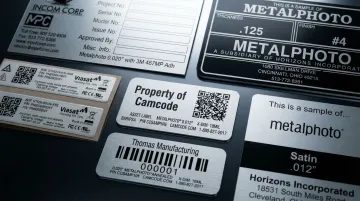
| Metalphoto (Anodized Aluminum) | Up to 1,000°F | Extreme heat, corrosive environments, permanent outdoor assets |
| Stainless Steel | Extreme temperatures | Corrosive chemicals, permanent asset ID, long-term outdoor use |
Polyester labels offer high resistance to moisture, abrasion, and moderate-to-harsh chemicals, making them ideal for equipment rating plates and warning labels. Polyimide resists most chemicals, solvents, lubricants, and fuels, with continuous service at temperatures where other materials fail. For extreme longevity, Metalphoto is tested for 20+ year outdoor life, surviving decades of sunlight, salt spray, and abrasion without fading.
Adhesive Selection Matters as Much as the Facestock
Even a durable label facestock can fail with the wrong adhesive. Key adhesive types include:
- Permanent adhesives for long-term asset identification
- Removable adhesives for temporary marking or seasonal labeling
- Aggressive adhesives for low-surface-energy plastics (polyethylene, polypropylene)
- High-temperature adhesives for furnaces, engines, or autoclaves
- Specialty adhesives for bonds to wet, oily, or contaminated surfaces
Match the adhesive to both the surface texture and the environmental conditions to ensure the label remains in place throughout its intended lifespan.
Print Method Affects Long-Term Readability
The print method directly affects longevity. Thermal transfer printing melts ink from a ribbon onto the label substrate, creating archival-quality labels that withstand temperature extremes, UV exposure, and harsh chemicals. The ink bonds into the material rather than sitting on the surface, making it resistant to fading, smearing, and chemical degradation—a critical advantage for safety-critical identification labels in industrial environments.