Introduction
Picture a server room at 2 a.m.: racks of tangled, unlabeled cables snake through panels, and a critical circuit has tripped. Without clear wire identification, technicians waste hours tracing connections, risking costly downtime and safety hazards. According to the Uptime Institute, 54% of severe data center outages cost over $100,000, with 40% of incidents driven by human error and procedural failures—problems that proper cable labeling directly addresses.
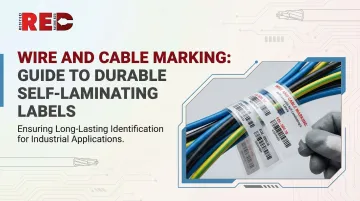
That's where self-laminating labels come in. They use a printed section paired with a clear protective tail that wraps over the text, creating a built-in laminate shield — no separate laminator required. This construction outperforms standard adhesive labels in harsh environments, protecting identification from moisture, abrasion, and chemicals.
This guide walks electricians, technicians, and facility managers through everything needed to get it right: how self-laminating labels work, how to apply them, and how to select the correct label for your wire diameter and environment.
Key Takeaways
- Self-laminating labels feature a transparent tail that wraps around wires, protecting printed text from moisture, abrasion, and chemicals
- Compatible with wires from 18 AWG to 1000 kcmil and print methods including thermal transfer, laser, and inkjet
- Proper selection requires matching label size to wire gauge and choosing materials rated for your specific environment
- Outperform standard adhesive and flag-style tags across industrial, electrical, and network installations
What Are Self-Laminating Wire and Cable Labels?
Self-laminating labels are wire markers with a printed section and an attached clear polyester or vinyl tail that wraps over the text after application, creating a protective laminate without a separate laminating step.
Label Anatomy
Each label consists of three zones:
- Printable area — White or colored section where you print circuit numbers, wire IDs, voltage warnings, or other identification
- Adhesive underside — Bonds the label to the wire surface
- Clear over-laminate tail — Transparent section that wraps over the printed area, sealing it beneath a protective layer
How the Wrap-Around Application Works
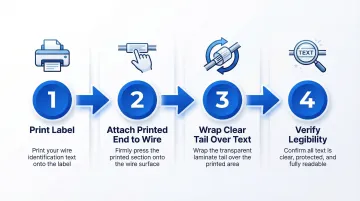
Application is straightforward: attach the printed end to the wire first, then wrap the clear tail around the wire so it overlaps the printed area and adheres to itself. This creates a sleeve-like configuration that locks the text underneath a protective shield.
Wire Diameter Compatibility
Self-laminating labels accommodate wire gauges from 18 AWG control wires to 1000 kcmil power cables. For example, TE Connectivity's SBP series fits wire diameters from 2.7 mm to 48 mm, while Panduit's S100X series covers Category 5e/6 network cables up to 250 MCM power cables.
Matching label size to wire diameter is critical: oversized labels create overlapping layers that obscure text, while undersized labels won't wrap around the wire completely.
How They Differ from Other Wire Markers
- Heat shrink labels — Require a heat gun and must be applied before termination; excellent for permanent installations but impractical for retrofits
- Pre-printed cable ties — Fixed text only; can't accommodate custom circuit IDs or revision changes in the field
- Standard vinyl wraps — No laminate protection; text smears or fades when exposed to moisture or handling
That combination of on-demand printing, retrofit-friendly application, and sealed protection is what makes self-laminating labels the default choice in most industrial wiring environments.
Key Durability Features That Make Self-Laminating Labels Stand Out
Moisture and Humidity Resistance
The clear over-laminate seals printed text so water, condensation, and cleaning fluids cannot smear or degrade ink. This matters in outdoor electrical panels, HVAC systems, marine environments, and anywhere cables face moisture exposure.
Poor cable labeling directly contributes to network downtime, forcing technicians to trace connections manually during critical outages. Illegible, moisture-damaged labels make that process significantly harder.
Abrasion and Physical Wear Resistance
Wires are bundled, pulled through conduit, and handled repeatedly during installation and maintenance. The laminate layer prevents text from rubbing off through physical contact. This is one of the most common failure modes for standard adhesive labels.
Chemical Resistance
In manufacturing and industrial settings, wires encounter solvents, oils, and cleaning agents. The polyester or vinyl laminate acts as a chemical barrier:
- Vinyl labels (like Brady B-427) resist general cleaning fluids but are destroyed by harsh solvents such as MEK, acetone, and aviation fluids like Skydrol
- Polyester labels (like HellermannTyton TAG49LA4) offer excellent resistance to alcohol, gasoline, battery acid, and industrial solvents
Temperature and UV Resistance
Operating temperature ranges vary by material:
- Standard vinyl — Rated from -40°F to 158°F (-40°C to 70°C)
- Industrial vinyl — Extended range to -40°F to 230°F (-40°C to 110°C)
- Polyester (PET) — Superior heat resistance from -40°F to 302°F (-40°C to 150°C)
For outdoor installations, UV exposure eventually causes text to fade, laminates to yellow, and labels to fail inspection. Panduit's S100X polyester labels show no significant degradation after 3,000 hours of ASTM G154 UV testing — equivalent to 5 years of outdoor exposure. Standard vinyl, by contrast, typically shows visible degradation within 5-7 years outdoors.
That performance gap matters when auditors check whether your labels still meet regulatory requirements years after installation.
Compliance and Standards Support
Several U.S. codes require durable, legible wire marking by law:
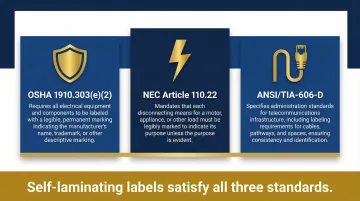
- OSHA 1910.303(e)(2) mandates that electrical equipment markings "shall be of sufficient durability to withstand the environment involved"
- NEC Article 110.22 requires disconnecting means to be legibly marked with durable identification
- ANSI/TIA-606-D specifies that telecommunications cables must carry machine-printed labels at both ends
Self-laminating labels are among the few label types that satisfy all three standards in a single product — the polyester or vinyl construction handles the environment, and the over-laminate protects the printed text for the life of the installation.
How to Apply Self-Laminating Wire Labels Step by Step
Step 1: Print Your Label
Print circuit IDs, wire numbers, voltage levels, or other data before application. Three print methods work with self-laminating labels:
- Thermal transfer produces the most durable output; use resin or wax-resin ribbons for smudge-free, fade-resistant text that holds up against chemicals and abrasion
- Laser delivers high resolution but requires specially coated polyester with heat-resistant adhesives to survive fuser temperatures
- Inkjet works for low-volume jobs; let ink dry completely before laminating to avoid smearing
Step 2: Position and Attach the Printed End
Align the printed portion at the wire, pressing the adhesive section firmly from one edge to avoid air bubbles. The clear tail should extend away from the wire, ready to wrap.
Step 3: Wrap the Clear Tail Over the Printed Area
Pull the clear laminate over the text and wrap it around the wire until it overlaps the adhesive section. This sleeve-like seal locks the label in place.
Step 4: Verify Placement and Legibility
Rotate the label to confirm the printed text faces outward and is fully protected under the clear layer. No printed area should be exposed at the seam.
Tip: If using thermal transfer printing, allow the ribbon ink to fully set (1-2 minutes) before applying the label to prevent smudging during the wrap process.
How to Choose the Right Self-Laminating Label
Match Label Size to Wire Diameter
Each label is designed for a specific wire diameter range. Applying a label sized for large cables on a thin wire creates overlapping layers that obscure text. Conversely, a small label on a thick wire won't wrap properly, leaving gaps that expose the printed area.
Always consult the manufacturer's wire-diameter-to-label-size chart before ordering. Most suppliers provide detailed sizing tables that map wire gauge (AWG) or diameter (mm) to the correct label SKU.
Select Material Based on Environment
| Material | Temperature Range | Best For |
|---|---|---|
| Vinyl (PVC) | -40°F to 158°F | Indoor panels, general electrical, datacom |
| Industrial Vinyl | -40°F to 230°F | Higher-heat indoor environments, moderate chemical exposure |
| Polyester (PET) | -40°F to 302°F | High-heat areas, industrial chemical exposure, outdoor UV exposure |
| Polyvinyl Fluoride (PVF) | Extreme ranges | Aerospace, military, semiconductor applications |
For manufacturing and construction environments where wires face vibration, fluids, and repeated service access, polyester labels provide superior durability. RE&D carries self-laminating labels in all of the above materials, including custom configurations — reach their team at 1-800-552-3127 or sales@redsafetyids.com.
Consider Print Method Compatibility
Once you've selected a material, confirm it's compatible with your printer. Not all labels work with every printer. Laser-compatible labels have different coatings than thermal transfer labels. Using the wrong stock can cause:
- Ink adhesion failure (print rubs off immediately)
- Adhesive bleed (melts in laser printer fusers)
- Printer damage (vinyl melts onto internal components)
Always verify that your label stock matches your printer technology before ordering.
Self-Laminating Labels vs. Other Wire Marking Options
Heat Shrink Labels
Heat shrink labels offer permanent, professional-grade identification with excellent abrasion and vibration resistance — ideal for OEM production and new harness assembly. The trade-off is application timing: the sleeve must slide over the wire before connectors are attached, and heat gun shrinking requires 194°F–248°F for standard polyolefin tubing (up to 650°F for PTFE). Once a panel is live or a harness is terminated, heat shrink isn't an option.
Best use: New construction and manufacturing where wires can be pre-labeled before termination.
Cable Tags (Flag or Tie-On Style)
Strengths: Visible without rotating the wire. Works on large-diameter cables, conduit bundles, and hydraulic hoses where wrap-around labels are impractical.
Limitations: Can snag on other equipment or pull free if the tie loosens — less secure than wrap-around labels.
Best use: Thick power cables and large bundles where visibility from a distance matters.
Pre-Printed Wire Sleeves
Strengths: Fast application for repetitive labeling — common circuit numbers, phase identification, and other standardized codes go on quickly.
Limitations: Inflexible. They can't accommodate custom IDs or one-off circuit numbers, so any deviation from the standard scheme means ordering new stock.
Best use: High-volume production runs where identification schemes don't change.
When Self-Laminating Labels Win
Self-laminating labels excel in:
- Retrofit projects — Can be applied to terminated wires without disconnection
- Mixed wire sizes — Available in sizes for every gauge from control wires to power cables
- Custom IDs — Print any alphanumeric combination on demand
- Moderate to harsh environments — Polyester variants withstand heat, chemicals, and UV exposure
Industries and Common Applications
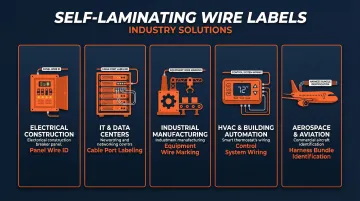
Self-laminating labels serve industries where wire identification directly impacts safety, compliance, and operational efficiency:
Primary Industries
- Electrical construction and panel wiring — NEC-compliant circuit identification in breaker panels, control cabinets, and switchgear
- IT and data center cable management — Network labeling to ANSI/TIA-606-D standards, cutting troubleshooting time during outages
- Industrial manufacturing floor controls — PLC wiring and sensor connections exposed to vibration, oils, and cleaning chemicals
- HVAC and building automation — Control wiring in air handlers and mechanical rooms where moisture and temperature swings are constant
- Aerospace and aviation wiring harnesses — Polyester or PVF labels meeting strict flammability and outgassing requirements
Why Durability Matters in Manufacturing and Construction
In manufacturing and construction, wires face constant exposure to vibration, fluids, and repeated service access. When labels fail, technicians waste time tracing circuits and the risk of wiring errors climbs. Durable identification is an operational safety requirement — it prevents costly mistakes and keeps maintenance moving. RE&D has supplied these industries with safety identification products for over 30 years, which shapes how the company approaches wire labeling solutions for demanding environments.
Frequently Asked Questions
What are self-laminating wire labels?
Self-laminating labels are wire markers with a printed section and a clear over-laminate tail that wraps around the wire to protect text from moisture, abrasion, and chemicals without needing a separate laminating step.
Are self-laminating labels waterproof?
The clear polyester or vinyl laminate provides strong water and moisture resistance, but full waterproofing depends on adhesive quality and material. Labels used in submersion or consistently wet environments may require additional specifications or alternative solutions.
How long do self-laminating cable labels last?
Quality polyester labels in protected indoor environments can last 10+ years. Outdoor or chemical-exposure conditions typically shorten this to 5-7 years. Select materials specifically rated for your environment.
Can I print self-laminating labels with a regular office printer?
Some self-laminating labels are laser-printer compatible, but industrial durability requires thermal transfer printing. Using incompatible label stock can damage your printer and produce labels with poor ink adhesion that fail quickly.
What size self-laminating label do I need for my wire?
Label size must match the wire's outer diameter. Too large creates overlapping layers that obscure text; too small won't wrap fully. Always consult the manufacturer's wire-diameter sizing chart before ordering.
What are the alternatives to cable tags?
Common alternatives include heat shrink tubing labels, adhesive flag markers, and pre-printed wire sleeves. The best choice depends on wire diameter, environment, and whether custom identification is needed.
Need help selecting the right self-laminating labels for your application? RE&D manufactures and distributes safety identification products for manufacturing and construction industries. Contact their team at 1-800-552-3127 or sales@redsafetyids.com for product specifications and custom solutions.