Introduction
Industrial buyers face a real cost when they select the wrong label material for manufacturing, construction, and safety applications. The wrong facestock leads to labels that fade, peel, or fail in the field—creating safety hazards, compliance violations, and costly operational disruptions. Material incompatibility is one of the most common drivers of label-related product recalls.
In industrial environments, self-adhesive labels are the frontline tool for safety identification, asset tracking, and hazard communication. Under OSHA's Hazard Communication Standard (29 CFR 1910.1200), labels must stay legible and attached for their entire service life—so material selection carries regulatory weight, not just operational preference.
This guide covers the main facestock materials, adhesive types, and a practical selection framework to help industrial operations match materials to their specific environments and regulatory requirements.
Key Takeaways
- Self-adhesive labels have three layers—facestock, adhesive, and liner—and each layer directly affects label performance
- Polyester (PET) withstands extreme conditions (-40°F to 300°F) and is the standard for industrial safety labels
- Vinyl handles curved surfaces and outdoor equipment well; cast grades hold up for 5–12 years outdoors
- Paper works only for dry, indoor, short-term applications—moisture causes immediate failure
- Low-energy plastics (like polyethylene or polypropylene) need specialized adhesive formulations to bond reliably
What Makes Up a Self-Adhesive Label?
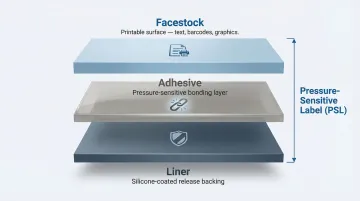
Self-adhesive labels, also known as pressure-sensitive labels (PSLs), consist of three distinct layers that work together to deliver reliable performance. The facestock is the printable surface material that displays text, barcodes, and graphics. The adhesive is the bonding layer that attaches the label to the target surface. The liner is the silicone-coated release backing that protects the adhesive until application. Each layer is independently customizable, allowing manufacturers to engineer labels for specific environmental demands.
Liner Options: Paper vs. Film
Paper liners (supercalendered kraft or glassine) are the most economical and widely used option. They offer good lay-flat characteristics and are suitable for most standard applications. However, paper liners have inconsistent thickness and can fracture during die-cutting or break under the tension of high-speed automated dispensing.
Film liners (polyester or polypropylene) provide superior dimensional stability and tensile strength. Their consistent thickness allows for more forgiving die cuts, and their resistance to tearing significantly reduces web breaks and machine jams during high-speed application. Film liners are also unaffected by humidity, preventing the curling issues common with paper.
Linerless labels eliminate the release liner entirely by applying a silicone release coating directly to the label face. This approach reduces material waste by up to 50% and increases roll capacity, cutting changeovers and shipping costs—a real advantage in high-volume logistics and warehousing operations.
Adhesive Chemistry: Acrylic vs. Rubber
The adhesive layer dictates environmental survivability and substrate compatibility. Two primary chemistries dominate industrial applications:
Acrylic adhesives offer superior resistance to elevated temperatures, UV light, chemicals, and solvents. They provide high internal strength and maintain bond integrity over years of service, making them the standard for long-term outdoor and harsh-environment use. The tradeoff: lower initial tack and difficulty bonding to low surface energy (LSE) plastics without special formulations.
Rubber adhesives provide high initial tack and bond rapidly to a wide range of substrates, including difficult LSE plastics. They work well on curved or uneven surfaces where immediate adhesion is critical. Their weakness is durability: UV exposure, oxidation, and heat cause degradation, limiting them to indoor or short-term applications.
Adhesive strength also varies by intended use:
- Permanent — bonds that cannot be removed without damaging the label or surface
- Semi-permanent — removable with significant effort, leaves minimal residue
- Removable/temporary — designed for clean removal without residue
Best Materials for Self-Adhesive Labels and Tags
The right label material depends on where it goes, what it touches, and how long it needs to last. Cost matters, but it should never be the primary driver — a failed label in a chemical plant or on a food package creates far bigger problems than a slightly higher per-unit price.
Paper (Matte and Gloss)
Paper facestock is the most widely used label material, commanding 63.70% of the self-adhesive labels market due to its cost-effectiveness and excellent printability. Available in matte, semi-gloss, and high-gloss finishes, paper delivers sharp text and high-density barcodes with exceptional clarity.
Where paper excels:
- Lowest cost per label across all facestock options
- Sharp print quality for thermal transfer, laser, and inkjet
- Compatible with virtually all standard label printing equipment
- Available in multiple textures, colors, and finishes
Where it fails: Paper absorbs moisture, causing ink to run and the substrate to degrade. Sun exposure causes fading and yellowing. It tears easily under stress — which rules it out for any application involving moisture, chemicals, or outdoor conditions.
| Specification | Details |
|---|---|
| Typical Use Cases | Indoor product labels, retail tags, office organization, short-cycle shipping |
| Durability Level | Low to moderate—fails in moisture or outdoor environments |
| Temperature Range | 32°F to 122°F (0°C to 50°C) |
| Printer Compatibility | Thermal transfer, laser, inkjet |
Vinyl (PVC)
Vinyl film is a flexible, weather-resistant material available in white, clear, and specialty finishes. Its high conformability allows it to wrap around curved or irregular surfaces without lifting—making it the standard for equipment labels, vehicle identification, and outdoor asset tags.
Vinyl is divided into two manufacturing categories with dramatically different performance characteristics:
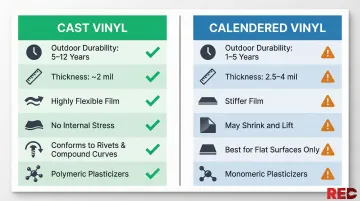
Cast vinyl is manufactured by pouring liquid PVC onto a casting sheet, producing a thin (~2 mil), highly flexible film with no internal stress. It uses high-grade polymeric plasticizers, providing 5 to 12 years of outdoor durability without shrinking or lifting.
This manufacturing method allows cast vinyl to conform to rivets, corrugations, and compound curves — making it the right choice for vehicle wraps and complex outdoor equipment.
Calendered vinyl is produced by rolling and heat-pressing solid PVC through heavy rollers, creating a thicker (2.5 to 4 mil), stiffer film. It often uses economy-grade monomeric plasticizers that migrate over time, causing the material to shrink, crack, and lift at edges. Outdoor lifespan is limited to 1 to 5 years. Best suited for flat, simple surfaces and short-term applications.
Clear vinyl provides a "no-label look" on glass and plastic substrates, offering high transparency for sleek packaging and window decorations.
| Specification | Cast Vinyl | Calendered Vinyl |
|---|---|---|
| Outdoor Durability | 5-12 years | 1-5 years |
| Temperature Range | Up to 248°F (120°C) | -40°F to 176°F |
| Chemical Resistance | High | Good |
| Typical Use Cases | Vehicle wraps, complex curves, long-term outdoor assets | Flat indoor/outdoor signage, short-term equipment labels |
| Printer Compatibility | Thermal transfer, digital print (check manufacturer specs) | Thermal transfer, digital print |
Polyester (PET)
Polyester is the most durable printable film available, engineered for extreme industrial environments. Industrial-grade PET facestocks withstand service temperatures from -40°F to 300°F (-40°C to 150°C) without shrinking or melting. This dimensional stability under heat ensures high-density barcodes remain scannable and do not warp—critical for automated tracking systems.
PET offers strong tensile strength, resistance to abrasion, solvents, UV exposure, and chemicals. It maintains legibility and adhesion through years of harsh exposure, making it the standard for UL 969-recognized marking and labeling systems used on electronics, automotive components, and chemical drums.
Why industrial buyers choose PET:
- Resists tearing and physical damage in high-contact environments
- Maintains outdoor durability for 3+ years in direct exposure
- Dimensionally stable — no stretching means barcodes scan accurately
- Available in white matte, white gloss, clear, and silver/metallic finishes
- Frequently UL 969-recognized for electrical equipment labeling
| Specification | Details |
|---|---|
| Typical Use Cases | Industrial safety labels, chemical drum labels, electrical equipment tags, high-temp environments, UL 969 nameplates |
| Service Temperature | -40°F to 300°F (-40°C to 150°C) |
| Durability Level | Very high—3+ years outdoor, chemical and abrasion resistant |
| Printer Compatibility | Thermal transfer (requires TTR topcoat), digital print |
Polypropylene (BOPP)
Biaxially Oriented Polypropylene (BOPP) is the industry-standard film for product labeling in food, beverage, cosmetics, and household goods. Manufacturers stretch it in two directions during production, creating a strong, flexible film with excellent clarity and moisture resistance.
BOPP resists oils, condensation, and off-gassing from acidic foods. Specific BOPP films comply with FDA 21 CFR 177.1520 for direct and indirect food contact, making them legally approved for use on food packaging. The material performs exceptionally well in refrigerated and moist environments where paper labels would fail immediately.
Where BOPP stands out:
- Waterproof, moisture-resistant, and oil/grease resistant
- High tear resistance with enough rigidity for automated label application
- More cost-effective than polyester for moderate-duty applications
- Slightly less chemically resistant than PET, but suitable for most food-safe environments
| Specification | Details |
|---|---|
| Typical Use Cases | Food and beverage labels, cosmetics packaging, refrigerated product labels, beverage bottles |
| Temperature Range | -4°F to 176°F (-20°C to 80°C) |
| Durability Level | Moderate to high—moisture, oil, and mild chemical resistance |
| Printer Compatibility | Thermal transfer, flexographic, digital |
Tyvek
DuPont Tyvek is a non-woven material made from flash-spun high-density polyethylene (HDPE) fibers bonded by heat and pressure. In practical terms, it handles like paper, holds up like film, and survives handling conditions that would destroy either. It tears with extreme difficulty even when punctured or stressed, resists moisture and chemical abrasion, and accepts thermal transfer printing cleanly.
These properties make Tyvek a strong choice for industrial hang tags, nursery and seed bag tags, security labels, and textile tags that must survive rough handling without failing.
Critical limitation: Tyvek is not inherently UV resistant. Uncoated Tyvek labels can only withstand outdoor exposure for one to three months before the material degrades and loses strength. For applications requiring 6 to 12 months or more of outdoor durability, labels must be protected with specialized UV coatings or overlaminates.
| Specification | Details |
|---|---|
| Typical Use Cases | Industrial hang tags, outdoor/nursery tags, security labels, textile and garment tags, medical packaging |
| Durability Level | High tear resistance, good moisture and abrasion resistance—outdoor durability 1-3 months uncoated, 6-12 months with UV topcoat |
| Temperature Range | Melts at 275°F (135°C) |
| Printer Compatibility | Thermal transfer, laser |
How to Choose the Right Self-Adhesive Label Material
Specify the wrong label material and you'll face adhesion failures, faded barcodes, or labels peeling off mid-shipment. Getting it right means working through four factors in order: application surface, environmental exposure, label lifespan, and print method compatibility.
Start with the Application Surface
Different materials bond differently to corrugated cardboard, paper, plastic, glass, metal, or textured surfaces. Matching adhesive aggressiveness to surface porosity is as important as the facestock choice.
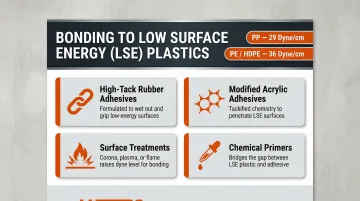
Surface energy governs adhesion success. High surface energy materials like aluminum (840 Dyne/cm) or glass (200-300 Dyne/cm) allow adhesives to spread evenly and create strong bonds. Low surface energy (LSE) plastics—defined as materials below 40 Dyne/cm—repel adhesives, causing them to bead up.
Common industrial containers made from Polypropylene (PP) and Polyethylene (PE/HDPE) have extremely low surface energies of approximately 29 Dyne/cm and 36 Dyne/cm, respectively. Standard acrylic adhesives can't spread properly across these surfaces—they bead up rather than bond.
To achieve reliable adhesion on LSE drums and containers, use:
- Specially formulated high-tack rubber adhesives designed for LSE surfaces
- Modified/tackified acrylic adhesives engineered to penetrate low-energy surfaces
- Surface treatments (corona, plasma, or flame) that artificially raise the plastic's dyne level
- Chemical primers that bridge between the LSE plastic and the adhesive
Evaluate Environmental Exposure
Walk through this environmental checklist to identify material requirements:
Moisture or water exposure?
- Paper fails immediately → Use BOPP or vinyl
Extreme temperatures (below 0°F or above 150°F)?
- Paper and BOPP fail → Use polyester (PET)
UV/sunlight exposure?
- Paper fades and yellows → Use vinyl or polyester
- Rubber adhesives degrade → Use acrylic adhesives
Chemical or solvent exposure?
- Paper and BOPP fail → Use polyester (PET)
- Ensure adhesive is chemically compatible
Physical abrasion or rough handling?
- Paper tears → Use polyester, vinyl, or Tyvek
- Consider protective overlaminate for extended life
Match Label Lifespan to Material Durability
Short-term labels (weeks to a few months): Paper or standard matte materials are cost-effective and sufficient for dry indoor conditions.
Medium-term labels (6 months to 2 years): BOPP or calendered vinyl provide adequate durability for moderate environmental exposure.
Long-term labels (3+ years): Equipment nameplates, safety tags, and regulatory compliance labels require durable film facestocks—polyester for harsh conditions, cast vinyl for outdoor curved surfaces.
Confirm Print Method Compatibility
Selecting an incompatible material leads to poor print quality or unreadable barcodes.
Thermal transfer printing requires facestock with a Thermal Transfer Receptive (TTR) topcoat. This coating lets wax, wax/resin, or pure resin ribbons melt and bond permanently—without it, the image smudges or scratches off easily.
Direct thermal printing uses heat-sensitive paper or film that darkens under the printhead. These labels stay reactive after printing: exposure above 122°F (50°C), direct sunlight, or strong fluorescent light can turn the entire label black, invalidating the barcode.
Inkjet printing on synthetic films requires specialized inkjet primers to prevent ink feathering and ensure rapid drying on non-porous surfaces.
Select the Right Adhesive Type
Adhesive chemistry directly determines whether a label stays put or fails—yet it's frequently the last thing specified:
Permanent acrylic adhesives are best for most industrial applications where the label must not be removed. They offer superior UV, chemical, and temperature resistance for long-term outdoor and harsh environment exposure.
Aggressive adhesives are needed for textured, rough, or low-energy surfaces like polyethylene drums. They provide higher initial tack to overcome surface challenges.
Semi-permanent adhesives work where re-labeling may be needed. They bond firmly but can be removed with effort.
Removable adhesives suit temporary marking or price tagging scenarios. They're designed for easy removal without residue.
When in doubt, request adhesive test samples from your supplier before committing to a full label run—especially for LSE plastics or extreme-temperature applications.
Industrial and Safety Label Material Considerations
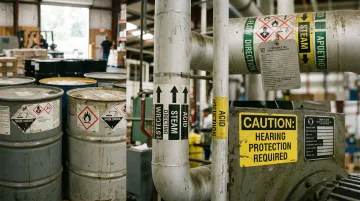
Safety identification labels in manufacturing and construction face demands that go beyond standard commercial labels. They must maintain legibility under chemical splash, heat, UV, and rough handling while meeting OSHA and GHS hazard communication standards. Selecting a material that fails prematurely creates compliance risk and potential safety hazards.
Under OSHA's Hazard Communication Standard (29 CFR 1910.1200), employers are responsible for maintaining labels "in a manner which continues to be legible and the pertinent information does not get defaced (i.e., fade, get washed off) or removed in any way." This places the burden on procurement and safety managers to select label materials durable enough to survive specific chemical exposures and environmental conditions.
For hazardous chemicals shipped via ocean freight, GHS labels must comply with British Standard BS5609 to meet International Maritime Dangerous Goods (IMDG) certification. BS5609 has two testing stages:
- Section 2 tests the blank label material and adhesive through three-month saltwater submersion, artificial weathering, and temperature cycling
- Section 3 tests the fully printed label, evaluating the facestock, adhesive, and printer/ink/ribbon system for print permanence after saltwater and UV exposure
Polyester and vinyl are the most frequently specified materials for industrial safety labels due to their resistance to the conditions described above. Polyester's exceptional chemical resistance and temperature stability make it ideal for chemical drums, electrical equipment, and high-heat environments. Cast vinyl's conformability and outdoor durability make it the standard for curved equipment and vehicle safety markings.
Protective overlaminates and varnishes shield underlying inks from UV fading, harsh solvents (like acetone and brake fluid), and mechanical scuffing. In UL 969 testing, labels subjected to defacement and chemical rub tests often require overlamination to maintain legibility and compliance under maximum temperature and outdoor exposure ratings.
RE&D (Rodgers Enterprises and Distributors Inc.), with over 33 years of experience manufacturing and distributing safety identification products, helps manufacturing and construction operations select the right label materials for their specific applications. Contact the RE&D team at 1-800-552-3127 or sales@redsafetyids.com for a product consultation.
Conclusion
There is no single "best" label material—the right choice depends on a combination of surface type, environmental exposure, required lifespan, print method, and adhesive performance requirements. A paper label that costs $0.05 may seem economical until it fails in the field, causing production delays, compliance violations, or safety incidents.
A higher upfront investment in polyester or vinyl over paper prevents costly label failures, compliance issues, and safety risks in industrial environments. Match material to function: a safety warning label has different demands than an asset tracking tag or a regulatory compliance sign.
For organizations in manufacturing, construction, or any safety-critical industry, the stakes of a label failure extend well beyond a replaced sticker.
RE&D has manufactured and distributed safety identification products since 1992. Contact the team at redsafetyids.com or call 1-800-552-3127 to find the right label solution for your operation.
Frequently Asked Questions
What is the best material for self-adhesive labels?
The best material depends on the application. Polyester and vinyl are top choices for industrial, outdoor, and chemical-exposed environments, while paper is sufficient for indoor, short-term use. Evaluate your surface type, environmental conditions, and required lifespan before selecting.
What are self-adhesive labels made of?
Self-adhesive labels have three layers: a facestock (the printable surface), a pressure-sensitive adhesive, and a release liner. Common facestock materials include paper, vinyl, polyester, polypropylene, and Tyvek — each selected based on the end-use application.
What is the difference between paper and film label facestocks?
Paper facestocks are cost-effective and offer sharp print quality but are not moisture or chemical resistant. Film facestocks (polyester, vinyl, BOPP) are more durable, tear-resistant, and suited for demanding environments. Film is the standard for industrial and outdoor label applications.
Which label material is best for outdoor or industrial use?
Polyester (PET) is generally the top choice for industrial applications due to its high-temperature resistance, chemical resistance, and multi-year outdoor durability. Vinyl is preferred for curved surfaces and applications requiring conformability, such as equipment and vehicle labels.
How do I choose the right adhesive for self-adhesive labels?
Match adhesive strength to the application surface. Permanent acrylic adhesives work for most surfaces, while high-bond options are needed for textured or low-energy plastics. Removable adhesives suit temporary use. Confirm compatibility with both the surface material and operating temperature range.
Are there waterproof self-adhesive label materials?
Yes — vinyl, polyester, and BOPP are all waterproof film materials suited for wet or humid environments. Paper labels are not inherently waterproof; a laminate or varnish topcoat can help, but offers only moderate protection against light moisture.