Introduction
Construction sites rely on dozens of specialized tools — but few are as underestimated as tape. The wrong tape in the wrong application can mean damaged surfaces, failed insulation, cracked drywall, or serious safety hazards. In a 2022 incident at a Kansas plastics plant, an employee suffered fatal injuries when duct tape was improperly used to hold a machine safety interlock open, resulting in OSHA penalties of $292,421.
Construction tapes vary significantly in material, adhesive strength, and application — and the wrong choice can undo hours of careful work. Two well-documented failure modes illustrate this:
- Traditional cloth-backed duct tape breaks down within days under HVAC thermal stress, according to a Lawrence Berkeley National Laboratory study
- Masking tape left beyond its removal window transfers adhesive to surfaces, requiring chemical solvents or scraping to clean
This article covers 5 common types of construction tape, what makes each one different, and how to pick the right one for the job.
Key Takeaways
- Construction tapes are engineered for specific tasks, surfaces, and conditions — not interchangeable, and substitutions cause real problems
- The 5 most common types: duct tape, electrical tape, masking tape, drywall tape, and safety marking tape
- Wrong tape selection leads to surface damage, bond failure, or code violations on the job site
- Choose based on surface type, exposure conditions, how long the bond needs to hold, and the specific job
- Purpose-built tape costs only marginally more than general-purpose options, and far less than fixing a failed application
What Are Construction Tapes and Why Do They Matter?
Construction tape is a broad category of pressure-sensitive adhesive tapes engineered for specific tasks within building, renovation, and repair work. These tapes serve critical functions across job sites:
- Sealing gaps and air barriers in walls and roofing
- Insulating pipes, wiring, and HVAC components
- Protecting surfaces from paint, debris, and damage
- Reinforcing joints in drywall, flooring, and sheathing
- Marking hazards and restricted areas for site safety
Unlike household tapes, construction-grade tapes are formulated to meet demanding performance requirements: temperature resistance, moisture resistance, specific adhesion levels, or electrical insulation ratings. The global building and construction tapes market is projected to reach $7.15 billion by 2034, driven by infrastructure development and sustainable building demands — a sign that tape specification is becoming more deliberate, not less.
The real-world cost of poor tape selection is substantial. Accelerated aging tests show that standard cloth-backed duct tape fails within days under HVAC thermal stress — leading to costly rework and failed inspections. In one documented OSHA case, a 19-year-old worker fell 80 feet down an elevator shaft while applying masking tape to a door frame, an incident that underscores how job-site tape use intersects directly with worker safety.
Choosing the right tape for the task isn't a minor detail — it's a decision that affects performance, compliance, and the people on site.
5 Types of Construction Tapes and When to Use Them
Duct Tape
Limitations: Duct tape is not suitable for electrical insulation (cloth fibers are flammable at high voltage), it is not a permanent solution for structural repairs, and adhesive residue can be difficult to remove from finished surfaces. Despite its name, traditional cloth-backed duct tape should never be used to seal HVAC ducts. Lawrence Berkeley National Laboratory tests found that it fails catastrophically within days under thermal stress. California's Title 24 energy code explicitly prohibits cloth-backed, rubber-adhesive duct tapes for sealing HVAC joints and seams unless used in combination with mastic and clamps.
Electrical Tape
Features an open weave that eliminates the blisters and bubbles common with paper tape. Because it is self-adhesive, it eliminates the need for an initial embedding coat, saving application time. However, manufacturers strictly recommend that the first coat over fiberglass mesh tape must be a setting-type joint compound (hot mud), not a ready-mixed drying compound, to provide the necessary rigidity and prevent stretching.
Best suited for:
- Joining drywall sheets and reinforcing corners
- Finishing plasterboard before painting or skim coating
- High-humidity spaces like bathrooms and kitchens (fiberglass mesh preferred)
Limitations: Skipping drywall tape — or using the wrong type — is a common cause of cracking at seams after finishing. Paper tape requires more skill to apply without bubbling; mesh tape, while easier to apply, can be slightly more prone to cracking if the joint compound is applied too thin or if drying-type compound is used for the first coat.
Safety Marking Tape
Safety marking tape (also called floor marking tape or hazard tape) is a heavy-duty vinyl or polyethylene tape used to mark hazards, delineate work zones, identify pathways, and provide visual warnings on floors, equipment, and surfaces across active construction sites. It is designed for high visibility and durability under foot traffic and equipment movement.
Unlike every other tape on this list, safety marking tape serves a communication and compliance function rather than a structural or finishing one. Its primary role is regulatory compliance — OSHA 1910.22 mandates that permanent aisles and passageways be marked with lines 2 to 6 inches wide.
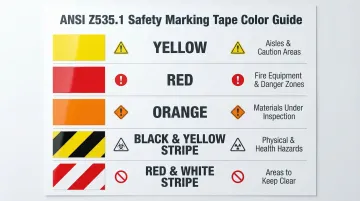
ANSI Z535.1 dictates specific color codes for safety marking:
- Yellow: Aisles, traffic lanes, and caution areas
- Red: Fire equipment, emergency stops, danger areas
- Orange: Materials held for inspection
- Black and Yellow Stripe: Physical/health hazards requiring extra caution
- Red and White Stripe: Areas to be kept clear for safety/compliance
RE&D manufactures vinyl marking tapes for construction and manufacturing environments, including Underground Detectable Tape, Arrow Banding Tape, and Blank Banding Tape for custom applications.
Best suited for:
- Marking pedestrian walkways and equipment exclusion zones
- Identifying hazardous areas and emergency egress paths
- Delineating storage boundaries on active construction and manufacturing sites
Limitations: Safety tape is not designed for structural, adhesive, or finishing tasks. Its adhesive is calibrated for floor surfaces under foot traffic — using it on walls, equipment, or non-floor surfaces may reduce effectiveness. It also requires clean, dry surfaces for proper adhesion.
How to Choose the Right Construction Tape for Your Job
Start with the task, not the tape
After reviewing the five tape types, the next step is matching them to your specific situation. The most common mistake is grabbing a familiar tape rather than identifying what the job actually requires. Start by defining the task:
- Insulating: Electrical tape only
- Sealing HVAC: UL 181-listed foil/film tapes
- Protecting surfaces: Masking or painter's tape
- Reinforcing joints: Drywall tape
- Marking hazards: Safety marking tape
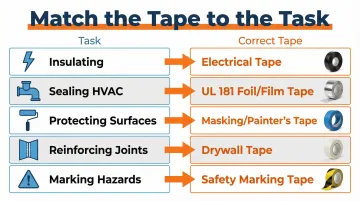
Then match the tape type to that function.
Consider surface type and condition
Different tapes bond differently depending on whether the surface is smooth, rough, porous, wet, freshly painted, or dusty.
Surface compatibility guidelines:
- High-adhesion tapes (duct tape): Work well on rough or uneven surfaces
- Light-adhesion tapes (masking and painter's tape): Suited for smooth or delicate surfaces
- Low surface energy materials (polyethylene, polypropylene, powder-coated paints): Require specialized tapes with highly aggressive tack or adhesion promoters
Dirty or dusty surfaces should always be cleaned before any tape is applied. Manufacturers recommend cleaning with a 50:50 mixture of isopropyl alcohol (IPA) and water prior to tape application. Porous surfaces like concrete and wood should be sealed with a primer or hard-surface coating before taping.
Factor in exposure conditions and duration
Whether the tape will be exposed to moisture, temperature extremes, UV light, or heavy traffic directly determines which tape will perform.
Exposure considerations:
- Short-term use: Masking tape (days to weeks maximum)
- Outdoor exposure: Contractor-grade duct tape, polyethylene tape, or exterior-rated safety marking tape
- UV exposure: Painter's tape has strict outdoor limits (1-60 days depending on product)
- High temperature: Electrical tape rated to 221°F; standard duct tape to 200°F
- Moisture: Fiberglass mesh drywall tape preferred in bathrooms and kitchens
Match adhesion level to removal requirements
Choosing a tape with appropriate tack is critical. Too strong, and removal damages surfaces; too weak, and the tape fails before the job is done.
Adhesion matching:
- Delicate surfaces/fresh paint: 3M 2080 (14 oz/in adhesion)
- Multi-surface applications: 3M 2090 (23 oz/in adhesion)
- High-tack needs: FrogTape Orange (39 oz/in adhesion)
Always test an unfamiliar tape on a hidden area before committing to full application.
Activate PSAs properly
Pressure-sensitive adhesives (PSAs) require physical force to flow into the microscopic peaks and valleys of a substrate. Apply at least 15 psi of pressure using a roller or platen — firm contact lets the adhesive flow into the surface and bond properly.
A light hand swipe isn't enough. Inadequate pressure leads to poor wet-out and eventual bond failure, even with the right tape for the job.
Common Tape Selection Mistakes on the Job Site
Using duct tape as a substitute for electrical tape
Substituting duct tape for electrical tape is one of the most dangerous mistakes on a construction site. Duct tape has zero dielectric strength, its adhesive degrades under heat, and its cloth backing is flammable at high voltage. Using it on electrical components violates both OSHA 1910.303 and NEC 110.3(B).
The risks include:
- Severe fire hazard from non-rated cloth backing
- Electrocution risk from adhesive breakdown under load
- Moisture absorption that accelerates insulation failure
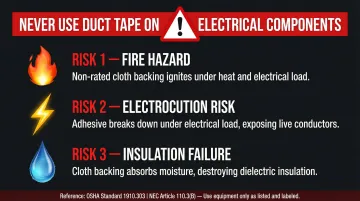
For any wiring application, use UL 510-listed PVC or rubber insulating tape — it's the only option that meets code.
Leaving masking or painter's tape on surfaces too long
Masking and painter's tapes are designed for short-term use. Left on finished walls, painted surfaces, or trim for days or weeks — particularly in warm weather — the adhesive cures into the substrate, causing peeling paint and residue that requires costly rework.
UV radiation accelerates this process significantly. Check the manufacturer's stated removal window (typically 14 days for standard painter's tape, shorter in direct sun) and pull the tape while it's still within that range.
Skipping drywall tape at plasterboard joints
It may be tempting to fill joints with compound alone, but this is a reliable path to cracking. Drywall tape is not optional — it provides the tensile reinforcement that prevents joint compound from splitting as the structure moves and settles. ASTM C475 and GA-216 mandate the use of joint tape. Without paper tape or fiberglass mesh bridging the joint, the compound has nothing to grip during structural movement — and it will crack.
Frequently Asked Questions
What is tape used for in construction?
Construction tape serves a wide range of functions including sealing and bonding materials, insulating electrical wiring, reinforcing drywall joints, masking surfaces during painting, and marking safety hazards. Selecting the right tape for the job prevents failures, damage, and rework.
What is the strongest construction tape?
Contractor-grade duct tape is the strongest for general adhesion due to its high-tack rubber adhesive and woven cloth backing, with tensile strengths ranging from 26 to 38 lbs/in. Reinforced filament tape offers the highest tensile strength for bundling and securing loads.
What are the different types of construction tape?
The most common types are duct tape, electrical tape, masking tape, painter's tape, drywall/scrim tape, safety marking tape, seam tape, and double-sided tape. Each is designed for a specific application and should not be used interchangeably.
Can I use masking tape instead of painter's tape?
Masking tape has higher tack (30 oz/in) and is better for general tasks, while painter's tape has a finer adhesive (14-23 oz/in) that releases cleanly from delicate or freshly painted surfaces. Using masking tape on finished walls increases the risk of surface damage or residue upon removal.
Is duct tape safe for electrical wiring?
No. Duct tape is not rated for electrical insulation, and its cloth backing is flammable at high voltages — making it a genuine fire hazard. Only UL 510-listed electrical tape is approved for wiring applications.
What type of construction tape works best outdoors?
Contractor-grade duct tape, polyethylene (PE) tape, and exterior-rated safety marking tape are your best outdoor options — all are weather-resistant and UV-stable. Masking, painter's, and paper-backed drywall tapes are for indoor use only.