
Introduction
Construction professionals routinely compare adhesive chemistries—acrylic versus butyl versus rubber-based—and scrutinize bond strength ratings before purchasing tape. Yet many overlook one of the most impactful specifications: width.
The consequences aren't trivial. Tape that's too narrow at a window flashing can allow water infiltration leading to mold remediation costs in the tens of thousands. Undersized seam tape on housewrap creates air leakage paths that compromise energy performance and void warranty coverage. Safety marking tape that's too narrow for high-traffic zones wears away fast, creating real liability exposure.
Width directly determines coverage area, bonding surface contact, ease of application around corners, and long-term seal integrity. Most projects default to whatever's on the shelf rather than specifying the right width — and that's where problems start.
This guide covers standard width ranges across major construction tape categories, the key factors that should drive width selection, and application-specific recommendations to help you specify the right tape the first time.
Key Takeaways
- Construction tape widths range from 2 inches (drywall, safety marking) to 9 inches or wider (window flashing), with the right choice depending on substrate and application
- Wider tape provides better coverage and bridges irregular surfaces but costs more per roll
- For housewrap seams, 2"–4" is standard; window and door flashing typically calls for 4"–9"
- Drywall joints use 2" tape; safety marking generally runs 2"–4" depending on lane width and visibility needs
- Substrate type, environmental exposure, and traffic load should all inform your width decision alongside adhesive type
What is Construction Tape and What Widths Are Available?
Construction tape refers to pressure-sensitive adhesive tapes engineered for building and renovation projects—sealing seams, flashing openings, managing moisture and air barriers, and marking safety zones. These are distinct from general-purpose packaging or office tapes in both adhesive formulation and dimensional specifications.
The main types used on construction sites include:
- Seam/housewrap tape for joining water-resistive barriers
- Flashing tape for waterproofing window and door openings
- Drywall joint tape for finishing gypsum board seams
- Duct tape for temporary holding and abatement
- Butyl tape for high-performance moisture sealing
- Safety/floor marking tape for hazard identification
Each category has distinct width requirements driven by the surfaces being sealed and performance demands.
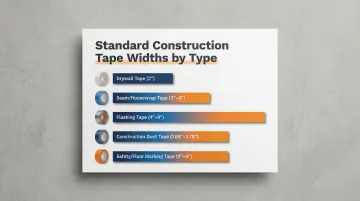
Common Width Ranges by Tape Type
- Drywall tape: 2" wide (industry standard for paper and mesh)
- Seam tapes (housewrap/sheathing): 2"–4"
- Flashing tapes (windows/doors): 4"–9" (sometimes up to 12")
- Construction duct tape: 1.88" (48mm) to 3.78" (96mm)
- Safety and floor marking tape: 2"–4"
These are standard stock sizes. Large-scale or specialized projects may require custom widths when standard dimensions don't provide adequate coverage.
Key Factors for Choosing the Right Construction Tape Width
The right width must match the specific joint, surface condition, traffic pattern, and performance requirement. The following factors help contractors and procurement teams make technically sound decisions.
Seam Width and Coverage Requirement
The width of the joint or gap being covered directly drives tape width selection. Tape must overlap both edges of the seam adequately—typically a minimum of 1 inch on each side—to create a functional seal.
Wider tapes provide more margin for error during application, especially on irregular or uneven substrates where precise alignment is difficult. On rough-cut lumber or OSB sheathing with surface variation, a 4" tape offers significantly more forgiveness than a 2" strip.
Application Type: Seaming vs. Flashing vs. Anchoring
Different applications demand different widths:
- Seam tapes (joining two panels or sheets) typically require narrower, highly adhesive strips
- Flashing tapes (used around penetrations, windows, and doors) must be wide enough to bridge the full transition zone and fold around corners without losing contact
- Anchor tapes (securing protection products to surrounding surfaces) need sufficient adhesive surface area to hold under job site traffic without damaging the underlying material
Industry testing has consistently identified narrow flashing tapes (under 4") as a common failure point in building envelopes, particularly around windows and door openings where water intrusion risk is highest.
Substrate Surface and Material
Substrate characteristics directly affect how well a given width performs. Wider tapes can bridge rough, porous, or slightly uneven surfaces—such as OSB or concrete—by distributing adhesive contact across a larger area.
Manufacturer specifications often dictate minimum widths for specific products. Huber's ZIP System sets 3-3/4" as the baseline for standard flat panel seams; DuPont requires 3" Tyvek Tape (rather than standard 2") for textured products like StuccoWrap and DrainWrap. Always verify these specs to maintain warranty coverage.
Traffic Load and Durability Demand
In high-traffic areas—active construction floors, entry points, temporary work zones—wider tapes provide more adhesive contact area, reducing the risk of peeling or displacement under foot traffic and equipment.
This is especially relevant for safety and floor marking tape. A 2" strip may suffice for low-traffic zones, but 3"–4" widths are more appropriate for heavily trafficked corridors where durability and visibility are critical.
Cost Efficiency and Material Waste
Durability and cost are closely linked—heavier-duty widths cost more per roll, but often reduce total spend by eliminating rework. Consider the per-application math:
- A single 3" strip covering a seam costs more per roll than 2" tape
- Two overlapping passes of 2" tape consume more labor time and create an extra failure point
- One 3" strip typically costs less overall when labor and material waste are factored in
If you're currently running two strips of 2" tape on the same seam, a single wider strip is almost always the better call.
Width Recommendations by Construction Application
Matching width to the specific task ensures optimal performance and cost efficiency.
Drywall Joint Taping
Recommended width: 2 inches
2-inch wide drywall tape (paper or mesh) is the industry standard for interior joint finishing, governed by ASTM C475. This width spans the typical factory joint width on standard drywall panels and is designed to be embedded in joint compound for a flush finish.
Going wider creates more problems than it solves. Wider tape makes feathering the compound more difficult, requires excessive material, and leaves visible ridges and shadows under critical lighting. Trade professionals consistently reject wider tapes for finish applications.
Housewrap and Sheathing Seam Tape
Recommended width: 2"–4"
2"–4" widths are standard for seaming water-resistive barriers (WRBs) and sheathing systems. 2" works for flat, clean seams on smooth surfaces, but 3"–4" provides better performance on rough-cut lumber, OSB, and exterior sheathing where surface variation is common.
Critical manufacturer requirements:
- DuPont Tyvek requires 3" tape (not standard 2") for textured products like StuccoWrap and DrainWrap, and mandates 6" overlaps between WRB courses
- Huber ZIP System establishes 3-3/4" as the baseline for standard flat panel seams
Failing to meet these specifications voids manufacturer warranties, a costly risk on large commercial projects.
Window and Door Flashing Tape
Recommended width: 4"–9" (sometimes up to 12")
Flashing tape must span the full width of a window or door flange, wrap around jamb corners, and extend adequately onto both the rough opening framing and the WRB for a watertight seal.
DuPont and Henry installation guidelines require flashing products to extend a minimum of 2 inches onto the WRB/sheathing and 2 inches onto the window flange or rough opening. A 2" or 3" tape cannot bridge that gap while maintaining adequate adhesion on both substrates.
Using tape that's too narrow is one of the most common sources of water infiltration in new construction. Building Science Corporation identifies narrow tapes (under 4") as a critical failure point. In this application, 4" is the practical minimum, with 6" and 9" widths providing significantly better performance.
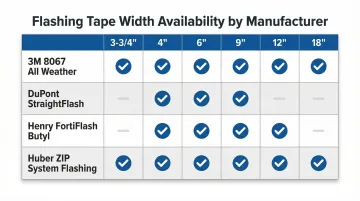
Standard flashing tape widths by manufacturer:
- 3M (8067 All Weather): 4", 6", 9", 12"
- DuPont (StraightFlash): 4", 9"
- Henry (FortiFlash Butyl): 4", 6", 9", 12", 18"
- Huber (ZIP System Flashing): 3-3/4", 6", 9", 12"
Safety and Floor Marking Tape
Recommended width: 2"–4"
Safety and hazard identification tape used on construction sites for lane marking, equipment zones, and walkway delineation typically comes in 2"–4" widths. 2" is common for light-duty or temporary markings, while 3"–4" provides better long-term visibility and durability in high-traffic areas.
OSHA guidance (29 CFR 1910.22): A 1972 OSHA interpretation letter clarifies aisle marking width requirements. The standard doesn't mandate a specific number, but the guidance is clear:
- 2" is the recognized legal minimum for aisle markings
- 2"–4" suits standard walkways and temporary site markings
- 4"–6" is recommended for forklift traffic zones and high-hazard areas
How RE&D Can Help You Source the Right Construction Tape
Rodgers Enterprises and Distributors Inc. (RE&D) has manufactured and distributed safety identification products since 1992 — giving them over 30 years of hands-on experience matching the right tape to the right job in construction and manufacturing settings.

RE&D offers multiple ordering options—phone, email, fax, or website—providing flexibility for how your team prefers to order materials. Their custom product manufacturing capabilities are particularly valuable when standard stock widths don't meet the specific demands of a project or facility.
Key reasons to work with RE&D:
- Broad catalog covering safety marking, underground detectable, and identification tape solutions
- Comprehensive catalog spanning safety and identification tape solutions
- Custom product development for specialized width or marking requirements
- Technical support team available to help match products to applications
Whether you're sourcing standard safety tape or need a custom width for a specific application, RE&D's team can walk you through the options before you order.
Contact RE&D at 1-800-552-3127 or sales@redsafetyids.com to discuss your project requirements.
Conclusion
Width is a foundational specification in construction tape selection—not a detail to default on. Matching width to the specific application (seaming, flashing, marking) directly affects moisture control, air barrier performance, and job site safety. The consequences of undersizing are real: water infiltration, voided warranties, failed inspections, and liability exposure.
Evaluate width alongside adhesive type, substrate compatibility, and environmental conditions—these decisions belong together. Tape specifications should be reviewed at the start of each project phase rather than carried over by default. Substrates change, manufacturers update requirements, and building codes evolve.
For each project, that means:
- Specifying width deliberately based on the application, not past habit
- Verifying manufacturer requirements before ordering, not after install
- Sourcing the right product for current substrates and code standards
Getting these details right upfront is far less expensive than tearing out failed seams or addressing moisture damage after the fact.
Frequently Asked Questions
What width drywall tape to use?
2-inch wide drywall tape is the standard width for interior joint finishing, as it matches the width of factory edges on standard drywall panels and allows for clean embedding in joint compound. Wider tapes make proper feathering nearly impossible and create visible ridges.
What is standard tape width?
"Standard" width varies by tape type:
- Drywall tape: 2"
- Housewrap seam tape: 2"–4"
- Flashing tape: 4"–9"
- Safety/floor marking tape: 2"–4"
Always verify manufacturer specifications for your specific application.
How do I choose the right width and length of hook and loop tape for my needs?
For hook and loop tape in construction applications, width should match the load-bearing or fastening surface area needed; wider strips provide more holding strength. Length is simply how much of the surface needs to be covered.
What width tape is best for sealing housewrap seams?
2"–4" is the standard range for housewrap seam tape, with 3"–4" preferred for rough or uneven surfaces. Always verify the WRB manufacturer's specified minimum tape width—DuPont requires 3" for textured wraps, and failing to comply voids warranty coverage.
Is wider construction tape always better?
Wider tape is not always better. It increases cost and can be harder to apply cleanly around corners or in tight spaces. Match width to the coverage requirement of your application, balancing performance, workability, and cost.
What width safety tape should I use for construction site floor markings?
2"–4" widths are most common for construction site floor and aisle marking. 3" or 4" tape is preferred in high-traffic zones for durability and visibility. OSHA guidance establishes 2" as the minimum acceptable width, with wider tapes recommended for forklift traffic areas.