Introduction
Manufacturing lines run at speed. Construction sites operate on tight schedules. In both environments, adhesive failures don't just cause downtime — they create safety hazards, trigger regulatory scrutiny, and generate rework costs that compound fast. Pressure-sensitive adhesive (PSA) tapes have become essential tools that replace mechanical fasteners, accelerate assembly, seal HVAC systems, and mark hazard zones — no heat, solvents, or curing time required.
Choosing the wrong tape, though, carries real consequences. A standard cloth duct tape on HVAC ductwork will fail inspection and void warranties. Thin vinyl in a forklift aisle tears within days, and rubber-based adhesive on low-surface-energy plastic simply peels off without ever bonding properly.
This guide breaks down the top five PSA tape types for industrial use — with the adhesive chemistry, backing materials, and performance ratings you need to make the right call for your facility's specific conditions.
Key Takeaways
- PSA tapes bond instantly on contact without heat or solvents—ideal for fast-paced industrial environments
- Top industrial types include acrylic foam, vinyl safety, aluminum foil, filament, and cloth duct tape
- Choose based on adhesive chemistry (rubber, acrylic, or silicone), surface energy, and temperature range
- Most common failure: using standard adhesives on low-surface-energy plastics (PE/PP) without primers
- For OSHA-compliant floor marking, specify vinyl tapes rated for forklift traffic
What Are Pressure-Sensitive Adhesive Tapes?
Pressure-sensitive adhesive tapes bond to surfaces using only applied pressure—no heat, water, or solvents required. The Pressure Sensitive Tape Council defines PSA tape as a continuous flexible strip coated with a permanently tacky adhesive at room temperature. It adheres with light finger pressure and requires no phase change.
Three core adhesive chemistries dominate industrial applications:
- Rubber (natural or synthetic): High initial tack, bonds well to most surfaces — but degrades faster under UV exposure and temperatures above 150°F
- Acrylic: Moderate initial tack with excellent long-term aging, UV resistance, and chemical resistance — the go-to choice for permanent industrial bonds
- Silicone: Handles extreme temperatures up to 500°F and bonds to silicone substrates, though initial tack is lower than rubber or acrylic
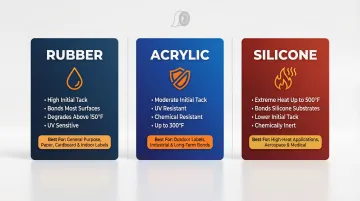
Adhesive chemistry determines performance, but construction type determines how that adhesive gets deployed. The four main configurations cover everything from basic surface protection to structural bonding:
Four main construction types:
- Single-coated: One adhesive side on a backing — common in foil tape and duct tape for surface protection or sealing
- Double-coated: Adhesive on both sides of a carrier film, used for mounting and lamination applications
- Transfer tape: Adhesive only, no carrier — applied via release liner for splicing and precision bonding
- Adhesive foam tape: Viscoelastic foam core with adhesive on both sides, suited for structural bonding and vibration damping
That range of options explains the scale of adoption across industries. The global pressure-sensitive tapes market was valued at $66.32 billion in 2023 and is projected to reach $92.45 billion by 2030 — driven by growth in automotive, construction, and manufacturing sectors as tapes take over bonding tasks once handled by mechanical fasteners.
Top Pressure-Sensitive Adhesive Tapes for Industrial Applications
These five PSA tape types cover the widest range of industrial needs — from structural bonding and floor safety to HVAC sealing and heavy-load strapping. Each was selected for proven performance under demanding conditions across manufacturing and construction environments.
Acrylic Foam Double-Sided Tape
Acrylic foam tape (commercially known by products like 3M VHB) is a double-sided, carrier-free foam tape used for structural bonding in place of mechanical fasteners. It bonds dissimilar materials (metal to plastic, glass to composites) and is widely used in panel mounting, sign assembly, automotive trim, and equipment fabrication.
Key differentiators:
- Viscoelastic foam core absorbs vibration and distributes stress across the bond line
- High-performance acrylic adhesive maintains bond strength from -40°F to 250°F
- Eliminates holes, rivets, and weld marks from finished surfaces
- Load-bearing variants reach tensile strengths up to 230 psi
| Property | Specification |
|---|---|
| Adhesive Type | Acrylic (solvent-free, high-tack) |
| Typical Temp. Range | -40°F to 200°F continuous; up to 300°F short-term |
| Key Industrial Uses | Panel mounting, façade bonding, equipment assembly, vibration damping |
Vinyl Safety & Floor Marking Tape
Vinyl PSA tape is the standard for floor marking, lane delineation, hazard identification, and safety signage in manufacturing plants and construction sites. It addresses OSHA workplace safety standards and adheres to concrete, tile, and painted surfaces.
Key differentiators:
- Tough PVC/vinyl backing resists forklift traffic, chemical spills, and abrasion
- Available in high-visibility colors and custom-printed formats for facility-specific safety messaging
- Heavy-duty variants (19–22 mil thickness) rated for forklift aisles prevent constant re-application
- Pressure-activated adhesive bonds to concrete, tile, and painted surfaces without surface prep
| Property | Specification |
|---|---|
| Adhesive Type | Rubber or acrylic, pressure-activated |
| Backing Material | PVC/vinyl (typically 5–22 mil thickness; ≥19 mil for forklift traffic) |
| Key Industrial Uses | Floor lane marking, hazard zones, aisle delineation, equipment ID, safety signage |
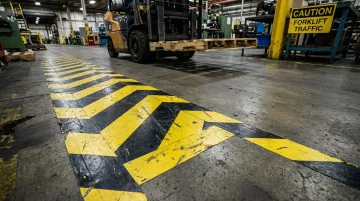
RE&D manufactures custom vinyl safety tapes with facility-specific color and label configurations for OSHA-compliant floor marking programs.
Aluminum Foil Tape
Aluminum foil tape is a single-sided PSA tape with a soft aluminum foil backing, widely used in HVAC ductwork, thermal insulation systems, construction vapor barriers, and industrial equipment sealing. It adheres to metal, glass, and rigid plastic substrates.
Key differentiators:
- Foil backing reflects radiant heat and provides a moisture/vapor barrier
- Acrylic adhesive maintains bond integrity across wide temperature swings
- UL 181A-P and UL 181B-FX listed variants required for HVAC duct sealing (standard cloth duct tape is explicitly rejected by building codes)
- Cold-weather formulations apply down to -20°F
| Property | Specification |
|---|---|
| Adhesive Type | Acrylic (cold-weather-capable variants available) |
| Backing Material | Soft aluminum foil (50–75 micron / 2.0–3.0 mil range) |
| Key Industrial Uses | HVAC duct sealing, insulation facing, vapor barrier joints, heat shielding |
Filament / Strapping Tape
Filament tape is a reinforced PSA tape with fiberglass or polyester yarns embedded in the backing, providing high tensile strength for bundling, palletizing, and securing heavy loads in manufacturing and distribution environments.
Key differentiators:
- Fiberglass filament reinforcement resists tearing and elongation under load
- Available in uni-directional (single load path) and cross-weave/bi-directional (multi-directional resistance) constructions
- Compatible with automated packaging lines
- Tensile strengths range from 100 lb/in (economy) to 333 lb/in (heavy-duty)
| Property | Specification |
|---|---|
| Adhesive Type | Rubber-based (high initial tack) |
| Tensile Strength | 100–333 lb/in depending on construction |
| Key Industrial Uses | Pallet strapping, bundling pipes and conduit, heavy carton reinforcement, securing equipment in transit |
Duct / Cloth Tape
Duct/cloth tape is a single-sided PSA tape with a woven cloth or scrim backing laminated to a polyethylene film, valued for its conformability, tear-by-hand usability, and multipurpose repair capabilities across construction, maintenance, and general industrial settings.
Key differentiators:
- Cloth backing conforms to irregular surfaces
- Rubber adhesive provides strong initial grab on a wide range of substrates
- Heavy-duty variants (reinforced scrim) rated for long-term outdoor exposure
- Critical limitation: Not UL 181 listed; building codes prohibit its use for HVAC duct sealing despite the name
| Property | Specification |
|---|---|
| Adhesive Type | Natural or synthetic rubber |
| Backing Material | Woven cloth/scrim + PE film laminate |
| Key Industrial Uses | Equipment repair, cable harnessing, surface protection, construction sealing, MRO maintenance |
Key Properties to Look for in Industrial PSA Tapes
Adhesive Chemistry Match
Rubber adhesives offer high initial tack and bond well to most surfaces, making them ideal for quick-stick applications like bundling and temporary repairs. However, they degrade faster under UV exposure and temperatures above 150°F, limiting their use in outdoor or high-heat environments.
Acrylic adhesives provide moderate initial tack but cure over time to a stronger, more durable bond. They excel in outdoor applications, high-temperature environments (up to 300°F), and chemical exposure scenarios. Acrylic is the preferred chemistry for permanent structural bonds.
For oven gaskets, heat shields, and high-temperature electrical insulation, silicone adhesives are the right call. They handle up to 500°F continuous with lower initial tack — and are the only option that bonds reliably to silicone substrates.
Surface Energy Compatibility
Surface energy determines whether an adhesive will "wet out" or spread across a substrate. High-surface-energy materials like steel (~500 mN/m) and glass (~1000 mN/m) bond easily with most tapes.
Low-surface-energy (LSE) substrates like polyethylene (PE) and polypropylene (PP) have surface energies around 31 mN/m. Standard acrylic adhesives will bead up on these surfaces rather than forming an intimate bond, which is a common cause of bond failures that go undetected until it's too late.
Solution: Specify LSE-rated adhesives (like 3M 300LSE) or use chemical adhesion promoters (like 3M Tape Primer 94) before bonding.
Temperature and Environmental Resistance
Industrial tapes must be spec'd for the operating environment—high-temp production lines, cold storage, chemical exposure, outdoor UV.
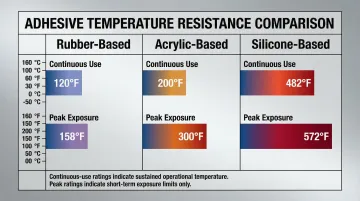
Critical distinction: Short-term temperature ratings (minutes to hours) differ significantly from continuous-use ratings (days to weeks). A tape rated for 300°F short-term may only handle 200°F continuous. Check both specs against your actual operating conditions before committing to a tape.
| Adhesive Type | Continuous Use Limit | Short-Term Peak |
|---|---|---|
| Rubber-based | 120°F (49°C) | 158°F (70°C) |
| Acrylic-based | 200°F (93°C) | 300°F (149°C) |
| Silicone-based | 482°F (250°C) | 572°F (300°C) |
Backing Material and Mechanical Durability
Backing material determines conformability, tear resistance, abrasion resistance, and whether the tape leaves residue upon removal.
- Vinyl backing: Excellent abrasion resistance for floor marking; conforms to smooth surfaces
- Foil backing: Provides moisture barrier and heat reflection; tears easily for clean application
- Cloth/scrim backing: High conformability to irregular surfaces; tear-by-hand convenience
- Foam backing: Absorbs vibration and accommodates surface irregularities in structural bonds
- Polyester backing: High tensile strength and dimensional stability for strapping applications
Regulatory and Compliance Requirements
Certain industrial applications require tapes with specific certifications:
- UL 181A-P / UL 181B-FX: Mandatory for HVAC duct sealing (aluminum foil tapes only)
- OSHA 29 CFR 1910.144: Red for fire equipment/danger, yellow for caution/physical hazards
- UL 723 (ASTM E-84): Flame spread and smoke development ratings for construction materials
A tape that passes UL 723 flame testing is not automatically approved for HVAC duct sealing — that requires a separate UL 181 listing. Verify the exact listing, not just the general standard, before purchase.
How We Chose the Best Industrial PSA Tapes
Every tape on this list was evaluated against criteria that matter in real industrial environments. That means verified performance data (temperature ratings, tensile strength, adhesion specs), confirmed end-use applications, and direct relevance to the manufacturing and construction sectors RE&D's customers work in.
Understanding those criteria also exposes where most purchasing decisions go wrong. These are the most common mistakes buyers make:
Where buyers go wrong:
- Selecting tape based solely on brand familiarity rather than adhesive chemistry compatibility
- Ignoring substrate surface energy—using standard adhesives on PE/PP plastics without primers
- Buying general-purpose tape for specialized applications like electrical insulation or floor marking where performance specs are non-negotiable
- Using cloth duct tape for HVAC duct sealing (prohibited by ENERGY STAR standards and most building codes)
- Specifying thin (5-mil) vinyl tape for forklift aisles when ≥19-mil rated tape is required
Conclusion
No single PSA tape is right for every industrial application. Matching adhesive chemistry, backing material, and performance specs to your substrate, environment, and compliance requirements is what separates a reliable bond from a costly failure.
Audit current tape usage on your floor—especially for safety marking, HVAC sealing, and high-load bonding—to ensure the right tape is in the right place. Check for:
- UL 181 listings on all HVAC duct tape
- ≥19-mil vinyl tape in forklift aisles
- LSE-rated adhesives on polyethylene and polypropylene substrates
- Temperature ratings that match actual operating conditions (continuous, not just short-term)
If that audit reveals gaps—particularly around floor marking and hazard labeling tapes—RE&D (Rodgers Enterprises and Distributors Inc.) has supported manufacturing and construction facilities with safety identification solutions for 33 years. Contact RE&D at 1-800-552-3127 or sales@redsafetyids.com to discuss custom options for your facility.
Frequently Asked Questions
What is the difference between rubber-based and acrylic PSA tape adhesives for industrial use?
Rubber adhesives offer higher initial tack and bond well to most surfaces but degrade faster with UV and heat exposure. Acrylic adhesives cure over time to a stronger bond and hold up better in outdoor, high-temperature, or chemical environments—making them the preferred choice for permanent industrial applications.
Can pressure-sensitive adhesive tapes replace mechanical fasteners in industrial assembly?
High-performance acrylic foam tapes (such as VHB-type) are engineered to replace rivets, screws, and welds by distributing load across the bond area and reducing stress concentrations. Success depends on proper substrate prep (cleaning, priming) and selecting the right tape for your surface energy and load requirements.
What temperature range can industrial PSA tapes typically handle?
Temperature resistance varies by adhesive type: rubber-based tapes handle up to 150–180°F, acrylic tapes up to 300°F, and silicone-based tapes up to 500°F or higher. Always verify both short-term and continuous-use ratings, as short-term ratings are consistently higher than continuous-use limits.
How do I know if a surface is compatible with the PSA tape I'm using?
Surface energy determines compatibility. High-surface-energy substrates (steel, glass) bond well with most tapes, while low-surface-energy plastics (PE, PP) require specialty LSE-rated adhesives or chemical primers. Clean and degrease all surfaces before application to maximize adhesion.
Do industrial PSA tapes have a shelf life, and how should they be stored?
Most manufacturers specify a shelf life of 12–24 months from the date of manufacture. Tapes should be stored in original packaging at 60°F to 80°F and 40% to 60% relative humidity, away from direct sunlight and temperature extremes, to maintain adhesive performance.
Are there PSA tapes specifically designed for OSHA-compliant floor marking in industrial facilities?
Yes—industrial vinyl floor marking tapes are available in OSHA-standard colors (yellow for caution, red for danger) with heavy-duty adhesives and ≥19-mil thickness rated for forklift traffic and chemical exposure. Custom-printed versions are also available for facility-specific safety programs and 5S visual management systems.