
Introduction
Picture this: A steel fabricator marks a critical weld seam with a standard marker, only to watch it fade completely after the first chemical bath. An inventory manager labels machine components with what seems like a "permanent" marker, but the marks smear under coolant within hours. A maintenance technician identifies pipe sections for inspection, only to find the part numbers have vanished after a single cleaning cycle.
These aren't hypothetical scenarios — they're daily frustrations in industrial environments where standard markers simply can't survive. Heavy-duty industrial markers are engineered for conditions that destroy consumer-grade tools: oily metals, aggressive solvents, extreme heat, and continuous weather exposure.
When the wrong marker fails on the job, the consequences go beyond inconvenience. Production stops, compliance documentation becomes impossible, and safety risks multiply.
This guide covers the top heavy-duty markers proven for industrial use, the technical criteria that separate reliable tools from failures, and how to match the right marker chemistry to your plant-floor conditions.
Key Takeaways
- Industrial markers use oil-based, paint-based, or ketone-based inks that bond to greasy, non-porous surfaces where standard markers fail
- Selection depends on ink chemistry, surface compatibility, chemical resistance, tip durability, and body construction
- Top picks include the Markal Pro-Line HP, Sharpie Industrial, Markal Pro-Max, Arro-Mark DG PM-68, and Sakura Paintstik
- Standard Sharpie markers use alcohol-based dye ink; industrial versions use pigmented paint or oil-based formulas with reinforced metal bodies
- Always verify VOC content, flammability ratings, and surface compatibility before using markers on the job
What Makes Heavy-Duty Industrial Markers Different?
Heavy-duty industrial markers are a distinct product class, not simply upgraded office markers. They're built with pigmented paint or specialty chemical inks, reinforced metal or impact-resistant bodies, and valve-action or capillary delivery systems designed for plant-floor conditions.
Core Ink Chemistry Differences
Consumer markers rely on water- or alcohol-based dye inks that evaporate quickly and lack adhesion to metal or oily surfaces. Industrial markers use fundamentally different chemistry:
- Oil-based inks – Bond directly to metal substrates and resist water/coolant exposure
- Solvent-based inks – Cut through grease films to reach the surface beneath
- Paint (pigmented) inks – Lay down opaque, weather-resistant marks with physical adhesion
- Ketone-based inks – Resist degreasing solvents and aggressive cleaning chemicals (for example, specialized ketone-formula markers used in heavy-degreasing environments)
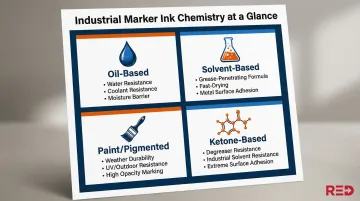
These formulas physically bond to substrates rather than just staining them, so marks hold up against weather, chemicals, and repeated cleaning.
Common Industrial Use Cases
Different industrial applications demand different marker specifications:
- Steel fabrication – Marking billets, beams, and forgings requires high-temperature solid paint
- Pipe identification – Tracking sections through yards needs weather-resistant liquid paint
- Weld inspection – Pre-heat and post-heat verification marks must survive torch exposure
- Machine shops – Part identification must withstand coolant baths and degreasing cycles
- Tire retreading – Marking cold or wet rubber requires specialized temporary formulas
- Inventory tracking – Warehouse labeling needs high-visibility marks on cardboard, drums, and lumber
Industry-Specific Requirements
Manufacturing, construction, oil & gas, steel fabrication, automotive, and aerospace sectors each have specialized marking requirements. For example:
- Stainless steel applications require chloride-free markers to prevent stress corrosion cracking
- Nuclear facilities mandate low-halogen markers meeting RDT F-7-3T specifications
- Food processing requires NSF-certified markers that won't contaminate products
- Confined spaces demand markers with specific VOC and flammability ratings
Selecting the wrong marker for your environment isn't just a performance issue — it can create compliance violations or safety hazards. For facilities that need markers integrated into a broader safety identification program alongside tags, labels, and signage, RE&D has served manufacturing and construction industries with custom identification solutions since 1992.
Top 5 Heavy-Duty Markers for Industrial Use
These five markers were selected based on proven industrial performance across manufacturing and construction environments. Key evaluation criteria included:
- Ink chemistry and surface compatibility
- Tip durability and body construction
- Resistance to coolants, solvents, and weather exposure
- Feedback from industrial procurement sources
Markal Pro-Line HP Paint Marker
Markal has built its reputation on industrial-grade marking tools. The Pro-Line HP is their high-performance liquid paint marker designed specifically for oily, greasy, or wet metal surfaces, which are routine conditions in machining, automotive, and metalworking environments.
The HP's specialized paint formula penetrates oil films to dry directly on the substrate, delivering bold, weather- and fade-resistant marks that remain legible through normal plant-floor handling, coolant exposure, and outdoor conditions.
| Feature | Specification |
|---|---|
| Tip Type / Line Width | Bullet tip; fine to medium line width suitable for part identification and labeling on metal surfaces |
| Ink Type / Resistance | Oil-based paint ink; resistant to water, coolants, oils, and outdoor weathering; quick-drying |
| Body / Best Use | Compact marker body; best for steel, iron, aluminum, and other metal surfaces in machining and fabrication environments |
Sharpie Industrial Permanent Marker
The Sharpie Industrial line differs fundamentally from standard Sharpie markers. It uses a harder pigmented ink formula with higher adhesion, a reinforced fiber tip resistant to abrasion, and is available in jumbo formats, making it a widely trusted general-purpose marker for shipping, inventory, and equipment labeling.
The Industrial line's ability to withstand temperatures up to 500°F and resist chemical washes sets it apart from consumer versions. Water- and smear-resistant once dry, it holds up well in warehouse and distribution environments.
| Feature | Specification |
|---|---|
| Tip Type / Line Width | Fine or chisel tip options; produces clear, high-visibility marks on multiple surfaces |
| Ink Type / Resistance | Alcohol-based permanent ink; water-resistant, smear-resistant once dry; heat-resistant up to 500°F; not recommended for chemical-immersion applications |
| Body / Best Use | Reinforced body; best for cardboard, plastic drums, lumber, metal surfaces in general warehousing, shipping, and inventory environments |
Markal Pro-Max Paint Marker
The Pro-Max is Markal's extra-large-capacity liquid paint marker, designed for high-visibility marking where bold, easily readable marks are required at a distance. Steel mills, pipe yards, construction sites, and material staging areas are its natural home.
The extra-large chisel tip lays down thick, opaque paint lines with excellent coverage on rough, uneven, or dark surfaces. The weather- and fade-resistant formula performs reliably outdoors and bonds to steel, iron, plastic, cardboard, and concrete.
| Feature | Specification |
|---|---|
| Tip Type / Line Width | Extra-large chisel tip (up to 9/16" wide); broad coverage for maximum visibility on large components and rough surfaces |
| Ink Type / Resistance | Water- and weather-resistant liquid paint; fade-resistant; suitable for indoor and outdoor industrial applications |
| Body / Best Use | Heavy-duty marker body with high paint capacity; best for steel yards, construction sites, pipe marking, and material identification at scale |
Arro-Mark Mighty Marker DG PM-68
The Mighty Marker DG PM-68 from Arro-Mark is a ketone-based pigmented paint marker built to resist degreasing solvents, cutting fluids, and coolants (water-based, synthetic, and semi-synthetic). That resistance to machine-part cleaning procedures is what separates it from standard alcohol- or xylene-based industrial markers.
The heavy-duty aluminum body includes a valve-action mechanism that prevents paint from drying when the cap is off. Replaceable bullet and chisel tips let you use the full paint reservoir, an important factor in high-use environments where marker longevity directly affects operating cost.
| Feature | Specification |
|---|---|
| Tip Type / Line Width | Replaceable bullet and chisel tips; versatile for labeling, coding, and identification marks on machined components |
| Ink Type / Resistance | Ketone-based pigmented paint; resistant to alcohol, degreasing solvents, coolants, and most industrial cleaning chemicals once dry |
| Body / Best Use | Heavy-duty aluminum barrel with valve-action mechanism; best for machine shops, metalworking facilities, aerospace, and any application involving aggressive part-cleaning procedures |
Sakura Solidified Paint Marker (Paintstik)
The Sakura Paintstik is a solid paint marker, a crayon-format tool using solidified oil-based paint. Unlike liquid markers, it does not run, drip, or roll off sloped surfaces, and produces marks that stay legible after exposure to elevated temperatures.
The format is particularly well-suited to steel production, welding inspection, and pipe marking, where liquid markers are impractical. Solid paint bonds directly to hot or cold metal and resists abrasion, moisture, and weathering.
| Feature | Specification |
|---|---|
| Tip Type / Line Width | Solid paint crayon tip; adjustable mark width depending on angle of application; no tip degradation from heat |
| Ink Type / Resistance | Solidified oil-based paint; heat-resistant (suitable for hot metal surfaces up to 392°F); weather-, moisture-, and abrasion-resistant |
| Body / Best Use | Compact solid-paint format; best for steel mills, welding, pipe fabrication, and marking hot or vertical metal surfaces where liquid markers are impractical |
Key Features to Look For When Buying Industrial Markers
When evaluating industrial markers, focus on these four critical criteria:
1. Ink Chemistry and Chemical Resistance
Match the ink type to the chemicals and solvents present in your environment:
- Oil-based inks – Best for water/coolant resistance but may not survive aggressive degreasers
- Ketone-based inks – Specifically engineered to resist degreasing baths and solvent cleaning
- Paint (pigmented) inks – Offer superior weather resistance and outdoor durability
- Alcohol-based inks – Adequate for general use but fail on oily surfaces or in chemical environments
Always consult the marker's Safety Data Sheet (SDS) to verify chemical compatibility with your specific cleaning agents, cutting fluids, or solvents.
2. Surface Compatibility
Not all markers bond to all substrates. Verify whether the marker is engineered for:
- Oily or greasy metal (requires oil-penetrating formula)
- Non-porous surfaces like glass, plastic, or rubber
- Rough or porous surfaces like concrete or unfinished wood
- Hot metal (requires solid paint or high-temperature liquid formula)
3. Tip Type and Durability
- Bullet tips produce fine, precise lines — ideal for part numbers and detailed labeling
- Chisel tips deliver broad, high-visibility marks for large-surface identification
- Solid paint tips work at any angle and resist heat and abrasion
- Replaceable tips extend marker life and reduce waste in high-volume environments
4. Body Construction
- Metal barrels (aluminum or steel) withstand drops and plant-floor abuse better than plastic
- Plastic bodies work in warehouse and shipping environments but may crack under heavy use
- Valve-action mechanisms store more paint, work at any angle, and won't dry out if left uncapped
How a marker delivers ink affects its reliability on the job — especially in high-volume or awkward-angle applications.
Valve-Action vs. Capillary-Action Markers
Valve-Action Markers:
- Store paint in a sealed reservoir
- Valve opens only when tip is pressed against a surface- Seal when recapped, so they won't dry out between uses
- Work at any angle (even upside down)
- Preferable for high-volume industrial use
Capillary-Action Markers:
- Use an absorbent sponge matrix to wick ink to the tip
- Dry faster if left uncapped
- Rely on gravity and fiber wicking
- Typically lower cost but shorter lifespan in industrial settings
Safety and Compliance Considerations
Industrial markers have VOC content and flammability ratings listed on their Safety Data Sheets. Facilities must evaluate:
- VOC emissions – Some markers contain up to 67% VOCs and require adequate ventilation
- Flammability ratings – Paint markers often have flash points below 50°F, creating fire hazards in confined spaces
- Halogen content – Nuclear, aerospace, and stainless steel applications require low-halogen or chloride-free certification
- Food-safe certification – Food processing environments need NSF-certified markers
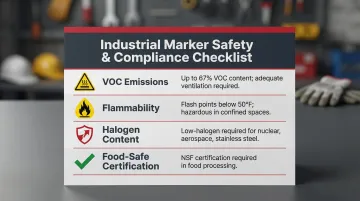
Always request and review the SDS before deploying markers in confined spaces, near ignition sources, or in applications with specific material restrictions.
How We Chose the Best Heavy-Duty Markers
This evaluation focused on industrial performance criteria—not color range or art-use features. Selection factors included:
- Ink chemistry and substrate adhesion – How well the ink bonds to industrial surfaces (metal, plastic, rubber)
- Resistance to chemicals/solvents/heat – Verified through manufacturer specifications and SDS data
- Body and tip durability – Construction quality and ability to withstand plant-floor handling
- Availability of Safety Data Sheets – Essential for compliance and safety evaluation
- Real-world use case alignment – Matching marker capabilities to manufacturing, construction, and heavy industrial environments
Common Buyer Mistakes
The most frequent procurement error is selecting markers based on brand name recognition alone. "Permanent" or "industrial strength" labels on packaging don't confirm whether the ink formula is compatible with your specific surface type and chemical exposure.
A standard marker will fail quickly on oily steel or in a degreasing bath regardless of what the label claims. Always verify ink chemistry and surface compatibility match your application before purchasing.
Conclusion
The right heavy-duty industrial marker is not a one-size-fits-all purchase. Facilities should assess the specific surface type, chemical environment, temperature range, and visibility requirements of their marking application before selecting a product—matching ink chemistry and body construction to actual operating conditions.
Procurement teams should request SDS documentation for any marker used in confined or chemically active environments, consider valve-action formats for high-volume use, and evaluate whether markers are part of a broader safety identification system.
RE&D (Rodgers Enterprises and Distributors Inc.) has manufactured and distributed safety identification products to manufacturing and construction industries since 1992. Based in Grove City, Pennsylvania, the company offers markers, custom tags, labels, safety signs, and identification solutions built for industrial environments.
Contact RE&D at sales@redsafetyids.com or 1-800-552-3127 to discuss your facility's marking and labeling requirements.
Frequently Asked Questions
What markers do industrial designers use?
Industrial designers (product and engineering designers) typically use fine-tip paint markers, oil-based permanent markers, or solidified paint markers for marking prototypes, metal parts, and tooling. Brands like Markal, Sharpie Industrial, and Sakura Paintstik are common choices on the shop floor due to their durability and adhesion to metal, plastic, and composite materials.
What is the difference between Sharpie and industrial Sharpie?
Standard Sharpie markers use dye-based alcohol ink in a plastic body with a fiber tip, designed primarily for paper and cardboard. Industrial Sharpie models use harder pigmented ink with higher adhesion, reinforced abrasion-resistant tips, and bodies designed to withstand industrial handling—making them more durable and better suited for non-paper surfaces like metal, plastic, and glass.
What is considered the best marker brand for industrial use?
Markal sets the benchmark for heavy industrial marking with its paint marker technology and broad surface versatility. Sharpie Industrial is the most accessible general-purpose option with broad distribution. Arro-Mark (Mighty Marker) is preferred for chemical-resistance-specific applications where markers must survive aggressive degreasing and solvent exposure.
Are industrial markers safe to use in enclosed workspaces?
Many industrial markers—particularly solvent-based, oil-based, and paint markers—emit VOCs and require adequate ventilation. Before use in confined spaces, consult the marker's SDS for flammability ratings, exposure limits, and required PPE; some formulas have flash points below 50°F, creating explosion hazards.
What type of industrial marker works best on oily or greasy metal surfaces?
Oil-penetrating paint markers—such as the Markal Pro-Line HP or the ketone-based Arro-Mark Mighty Marker DG—cut through oil films and bond directly to metal. Standard alcohol or water-based markers will bead off or smear without surface prep.
Can heavy-duty markers withstand extreme temperatures?
Liquid paint markers are rated for application up to 150°F, while solid paint markers like Sakura Paintstik handle hot surfaces and heat cycling up to 392°F. Always confirm the manufacturer's temperature rating for your application—welding, annealing, and forging often require specialized high-temperature formulas.