Introduction
According to the National Fire Protection Association, while flammable and combustible liquids are the first material ignited in only 5% of warehouse fires, they account for 11% of resulting civilian injuries. That disproportionate injury rate is why OSHA mandates flammable storage warning signage—no exceptions. Missing or inadequate signs contribute directly to fires, explosions, OSHA citations, and facility shutdowns.
Hazard Communication violations ranked #2 in OSHA's most frequently cited standards for 2024, with 2,888 violations—many tied directly to inadequate labeling and signage in flammable storage areas. This guide covers exactly what OSHA requires, where signs must be posted, and how to close the compliance gaps that trigger enforcement action.
Key Takeaways
- OSHA standards 29 CFR 1910.106 and 29 CFR 1926.152 mandate specific warning signs on cabinets and in hazardous areas
- Cabinet label wording differs between general industry and construction standards — exact phrasing is required
- Area warning signs must prohibit smoking and open flames in all dispensing, storage, and fueling zones
- OSHA's terms — "conspicuous," "readily visible," "legible" — are vague, but inspectors apply them strictly
- Missing or incorrect signs trigger citations; NFPA 30 provides supplemental signage guidance that OSHA recognizes
OSHA Flammable Storage Warning Sign Requirements: What the Law Requires
OSHA's flammable liquids standards—29 CFR 1910.106 for general industry and 29 CFR 1926.152 for construction—contain specific warning sign mandates that go beyond general hazard communication. These requirements are not suggestions; they are enforceable regulations with citation consequences.
"Flammable storage warning signs" encompasses two distinct obligations:
- Cabinet-level labeling — Signs affixed directly to storage cabinets
- Area warning signs — Posted signs in locations where fire or explosion hazards exist
OSHA classifies flammable liquids into four categories (Category 1 through 4) based on flash point and boiling point thresholds. Category 1 liquids are the most volatile and require the strictest controls, including prominent warning signage. Your liquid's category directly determines which warning signs are required and where they must appear.
Flammable Storage Cabinet Labeling Requirements
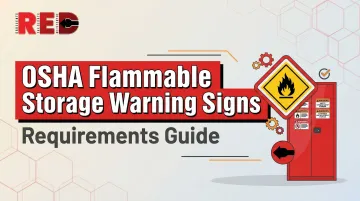
Both standards specify mandatory cabinet labeling with exact phrasing — not just a generic "Flammable" label. Under 1910.106(d)(3)(ii) and 1926.152(b)(2)(iii), required wording differs by standard:
- General Industry (1910.106): "Flammable - Keep Fire Away"
- Construction (1926.152): "Flammable-Keep Away from Open Flames"
Cabinet labeling is required independently of any area signs posted nearby — the cabinet must be marked regardless. A generic "Flammable" label without the required phrasing constitutes a violation.
Area Warning Signs for Fire and Explosion Hazard Zones
OSHA requires posted warning signs in any area where flammable vapors, liquids, or gases create a fire or explosion hazard. Common locations requiring posted signs include:
- Dispensing areas where flammable liquids are transferred
- Storage rooms housing flammable materials
- Fueling and service stations
- Any area where flammable vapors are normally present
Under 1926.152(g)(9), "conspicuous and legible signs prohibiting smoking" must be posted in service and fueling areas. The general industry standard contains parallel requirements for ignition source control in areas where flammable vapors are normally present.
What Flammable Storage Warning Signs Must Say
Exact wording matters. OSHA enforcement history shows that deviating from required phrasing creates a compliance gap even if intent is clear.
Cabinet label language:
- General industry: "Flammable – Keep Fire Away"
- Construction: "Flammable – Keep Away from Open Flames"
Area warning signs in flammable hazard zones must:
- Prohibit smoking
- Prohibit open flames
- Be readable to a "reasonable person" as a warning against fire or explosion risk
MSHA's compliance checklist criteria provide a useful benchmark for what "adequate" warning means. Signs must be visible from each approach, not just one angle.
GHS/HazCom Label Elements for Containers
Area signs cover the space — container labels are a separate requirement. OSHA's Hazard Communication standard requires six mandatory label elements on flammable liquid containers:
- Product identifier
- Signal word ("Danger" for Category 1–2, "Warning" for Category 3)
- Hazard statement (e.g., "Extremely flammable liquid and vapor" for Category 1)
- Pictogram (flame symbol for Categories 1–3)
- Precautionary statement(s)
- Responsible party contact information
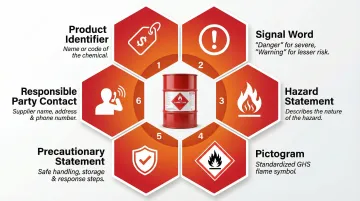
These apply to containers, not to posted area signs. However, both are required—container labels do not substitute for posted room or area signs.
For service and fueling areas specifically, "No Smoking" signs must be worded and positioned to be understood by any person entering the area. OSHA enforcement history shows inspectors expect these signs to stand alone as sufficient warnings without relying on verbal instruction.
RE&D manufactures flammable storage warning signs and labels in standard and custom formats, built to the language and visibility specifications of 29 CFR 1910.106 and 1926.152. Facilities that need both posted area signs and container labels can source both from a single supplier.
Where to Post Flammable Storage Warning Signs
OSHA's sign placement rules are location-dependent, not one-size-fits-all. The type of storage or operation determines exactly which signs are required and where they must appear.
Indoor Flammable Storage Areas and Cabinets
Any storage cabinet holding flammable liquids must have its required label visible on the exterior. For inside storage rooms, additional area warning signs must be posted at entry points where personnel may encounter flammable vapor or liquid hazards.
Containers in storage rooms must also carry their own compliant labels—posted room signs do not substitute for container-level labeling under HazCom requirements.
Dispensing and Transfer Areas
Areas where flammable liquids are transferred between containers in quantities greater than 5 gallons must have warning signs controlling ignition sources. OSHA requires these areas to be separated from other operations by 25 feet or protected by fire-resistant construction, and signage is part of that hazard communication.
"No Smoking" and open-flame prohibition signs carry particular weight in dispensing zones, where static electricity and vapor concentration create elevated ignition risk. The same sign requirements extend to fueling operations — where behavioral controls become the last line of defense against ignition.
Service, Fueling, and Refueling Areas
29 CFR 1926.152(g)(8)–(g)(9) explicitly requires "No Smoking" signs in all fueling areas. Motors must be off during fueling, and posted signs reinforce this behavioral control.
Placement matters as much as presence. Signs must meet these positioning requirements:
- Visible to anyone approaching the dispensing unit — not just those already inside
- Posted at each point of access to the fueling area
- Sized and positioned to be readable before personnel enter the hazard zone
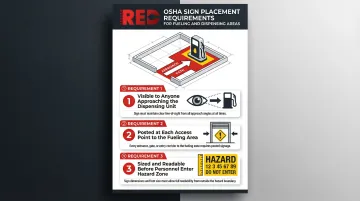
A 2019 OSHA citation against Lindsey Construction Co. shows the real-world cost of getting this wrong: two 500-gallon diesel tanks lacked "No Smoking" signs, leaving employees exposed to fire hazards.
Sign Visibility and Physical Specification Standards
OSHA uses the terms "conspicuous," "legible," and "readily visible" to describe required sign standards but does not define exact dimensions, font sizes, or colors for flammable storage warning signs specifically. In practice, signs must be large enough to be read from a reasonable approach distance without obstruction.
What ANSI Z535 Adds to OSHA's Requirements
ANSI Z535 standards for safety signs provide the industry benchmark many OSHA inspectors reference when evaluating whether a sign meets the "conspicuous and legible" threshold:
- Red/orange color coding for danger/warning
- Minimum letter heights based on viewing distance
- Durable materials that resist fading or chemical damage in industrial environments
ANSI Z535.2 provides a specific formula: Minimum Letter Height (inches) = Viewing Distance (feet) × 0.07
Maintaining Compliance Over Time
Signs obscured by equipment, damaged by chemical exposure, or faded from UV exposure can constitute a violation even if a sign was originally compliant. Compliance doesn't end at installation — signs must remain readable throughout their service life, which means scheduling regular inspections and replacing any sign that no longer meets the original standard.
Common Warning Sign Compliance Mistakes to Avoid
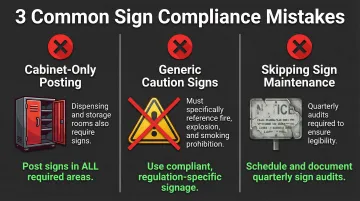
Posting Signs Only on the Cabinet
Many facilities label the cabinet correctly but fail to post warning signs in adjacent dispensing zones, storage rooms, or fueling areas. That partial compliance still draws citations.
In 2019, OSHA cited Optima Stantron Corp. because "No Smoking" signs were not conspicuously posted at all powder coating areas and powder storage rooms — not just the cabinet.
Using Generic "Caution" or "Hazard" Signs
A generic hazard marker does not satisfy the standard. OSHA and MSHA enforcement history shows that signs must specifically address fire or explosion risk and prohibit smoking or open flames — "Caution" alone does not cover it.
Skipping Sign Maintenance and Periodic Inspection
Facilities that passed an initial inspection but allowed signs to fade, become obstructed, or be removed during equipment rearrangements face citations for ongoing non-compliance. Assign responsibility for quarterly sign audits to ensure all required signs remain in place, legible, and unobstructed.
Conclusion
OSHA flammable storage warning sign compliance comes down to three things: correct language, complete placement, and sustained visibility. Miss any one of them and you've created both a safety gap and a compliance liability.
Treat sign audits as a routine part of flammable liquid storage inspections, not a one-time installation task. RE&D offers a range of safety identification products to help facilities keep compliant, readable signage in place across all flammable hazard areas. Contact the RE&D team at 1-800-552-3127 or sales@redsafetyids.com to discuss your specific signage requirements.
Frequently Asked Questions
What are the OSHA requirements for flammable storage?
OSHA's 29 CFR 1910.106 (general industry) and 29 CFR 1926.152 (construction) govern flammable liquid storage. Requirements cover approved containers, quantity limits, cabinet specifications, ventilation, fire control, and mandatory warning signs and labels. Non-compliance results in citations and puts workers at risk.
What are the requirements for flammable storage cabinets?
Cabinets must be metal or wood construction meeting fire resistance standards, hold no more than 60 gallons of Category 1–3 liquids or 120 gallons of Category 4, and display OSHA's required flammable warning language on the exterior — with exact phrasing varying between general industry and construction standards.
What flammable materials are required to display warning signs?
Any area where flammable liquids, flammable vapors, or flammable gases create a fire or explosion hazard requires posted warning signs. This includes storage cabinets, indoor storage rooms, dispensing areas, service/fueling areas, and transport areas. Container-level GHS labels are also required under the Hazard Communication standard.
What is the NFPA 30 flammable storage limit?
NFPA 30 (Flammable and Combustible Liquids Code) sets indoor quantity limits and addresses signage requirements alongside OSHA standards. OSHA recognizes current NFPA 30 editions as providing equal or greater protection, treating compliance as a de minimis violation.
What must flammable storage warning signs say per OSHA?
Cabinet labels must read "Flammable – Keep Fire Away" (general industry) or "Flammable – Keep Away from Open Flames" (construction). Area warning signs must prohibit smoking and open flames in conspicuous, legible language readable to any reasonable person. Generic "Caution" or "Hazard" signs without specific flammable/fire language do not meet OSHA requirements.