Introduction
In July 2024, a process upset at the Cuisine Solutions facility in Sterling, Virginia, released approximately 275 pounds of anhydrous ammonia—a toxic cloud that settled at ground level and sent 33 people to the hospital, including four with serious injuries. The Chemical Safety Board's investigation revealed a troubling pattern: the facility lacked a system-wide emergency shutdown procedure, no evacuation alarm sounded, and missing tags on pressure relief valves hindered verification of equipment service life.
Those missing tags weren't a paperwork problem — they were an operational failure with real consequences. In an emergency shutdown, first responders and operators wearing self-contained breathing apparatus (SCBA) and full-face masks have seconds to locate the right valve among hundreds.
When visual acuity is degraded by fogged respirator lenses and limited task lighting, a small ice-covered tag is no different from no tag at all.
This guide covers exactly which valves require signage and tags, which standards govern those requirements, what information must appear on each tag, and what broader facility signage keeps your system compliant with OSHA Process Safety Management (PSM), EPA Risk Management Program (RMP), and IIAR standards.
Key Takeaways
- IIAR 2 (new systems) and IIAR 9 (existing systems) require emergency shutdown valves to be uniquely identified at the valve and on P&IDs
- OSHA's PSM and Lockout/Tagout standards don't mandate valve tags by name, but valve tagging is the accepted method to satisfy RAGAGEP requirements
- Valve tags must include name, equipment ID, room location, line designation, and position — and must remain legible under emergency conditions
- Machinery rooms require door identification signs, ammonia alarm signs, and labeled emergency switches per IIAR standards
- Pipe markers per IIAR Bulletin 114 must show refrigerant identity, physical state, pressure level, system abbreviation, and flow direction
The Regulatory Framework Behind Ammonia Valve Labeling
No single regulation uses the exact phrase "install valve tags"—the requirement is distributed across OSHA standards and IIAR industry standards. Understanding how they work together is essential to staying compliant.
OSHA Lockout/Tagout and PSM Requirements
OSHA's Lockout/Tagout standard (29 CFR 1910.147) and PSM standard (29 CFR 1910.119) don't explicitly mandate valve tags. However, both require employers to ensure employees can safely apply and use energy controls (LOTO) and safely follow written operating procedures and P&IDs. Valve tagging directly supports these requirements by providing clear, physical identification that workers can reference during lockout procedures and emergency shutdowns.
RAGAGEP and the IIAR Standards
Under OSHA PSM, facilities must follow Recognized and Generally Accepted Good Engineering Practices (RAGAGEP). OSHA's 2015 and 2016 enforcement memos establish that RAGAGEP forms the basis for engineering, operation, and maintenance activities.
For ammonia refrigeration specifically, OSHA and EPA explicitly recognize IIAR standards as the governing RAGAGEP.
Facilities adopting IIAR standards as their RAGAGEP are bound by IIAR's minimum requirements, which include valve identification mandates:
- ANSI/IIAR 2-2021 Section 5.14.4 (new systems): Emergency shutdown valves must be "clearly and uniquely identified at the valve itself and in the system schematic drawings"
- ANSI/IIAR 9-2020 Section 7.2.9.3 (existing systems): Applies the same identification requirement to existing facilities
New and existing systems face the same standard. Physical valves and P&IDs must stay aligned — which makes valve identification an ongoing maintenance obligation rather than a one-time installation task.
Which Valves Require Tags and Labels?
The trigger for mandatory tagging is the equipment emergency shutdown procedure (SOP). Valves listed in emergency shutdown procedures are the ones that must be tagged. Facilities must reference their site-specific SOPs to determine the full scope.
Equipment Categories Requiring Valve Identification
Valves associated with the following equipment categories typically require identification:
- Compressors (main isolation valves, service valves)
- Condensers
- Evaporators
- Accumulators
- Recirculators
- Heat exchangers
- Oil pots and pressure vessels
- Auto-purgers
- Control valves (flow and pressure regulators)
P&ID Alignment Requirement
Every tagged valve must have a corresponding, matching identification on the system's Piping and Instrumentation Diagrams. The EPA Region 7 Accident Prevention Manual warns that inaccurate P&IDs "cause operating errors, delay efforts to minimize an ammonia release, and further increase the risks to emergency responders."
Discrepancies between physical tags and P&IDs are a common audit finding that undermines emergency response effectiveness. OSHA Citation 315026617/01002B penalized a facility because "piping and valves...were not all tagged / identified / labeled to correspond with the P&ID drawings."
Tagging Beyond the Minimum
Meeting the minimum requirement is the baseline — going beyond it is where good safety practice starts. Not every designer identifies the same valves—some include strainer IDs, others do not. Facilities may choose to tag additional valves, such as oil circuit valves on compressor packages, to better support safe work practices even if not strictly required by IIAR.
What Information Should Appear on a Valve Tag?
Valve tag content has evolved significantly over the past three decades, but readability under emergency conditions remains the critical design constraint.
Historical Baseline: Number-Only Tags
Early valve tags under PSM displayed only a unique number (e.g., "252" or "535"), with full valve specifications maintained in a separate Master Valve List. This system worked in routine operations, but cross-referencing a master list during an active ammonia release costs time responders cannot afford.
Modern Multi-Field Tags
Modern tags often include structured information:
- Valve name/type: HV-01 (Hand Valve 01), PR-03 (Pressure Regulator 03)
- Equipment ID: Links the valve to specific equipment
- Room location: F, G, Compressor Room A
- Line designation: HTRL (High Temperature Refrigerant Liquid)
- Valve position: N-O (Normally Open), N-C (Normally Closed)
- Valve size: 2", 3", 4"
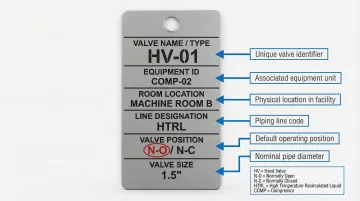
The tradeoff is that fitting all six fields onto a standard 3"×3" tag forces smaller font sizes—which creates a separate problem.
The Readability Tradeoff
As more information is packed onto a typical 3"×3" tag, font size shrinks. A responder wearing a full-face mask inside an encapsulated suit has limited ability to read dense, small text quickly. NIOSH testing requires 30 to 50 foot-candles of task lighting at the viewing distance, and peer-reviewed research demonstrates that visual tasks are highly sensitive to acuity degradation when wearing respiratory masks.
A tag with only a large, clear valve number may be more effective in a true emergency than a tag loaded with data in 8-point font.
When Placards Are More Appropriate
For king valves and other critical emergency shutdown valves, visible placards—not just hanging tags—improve response time. The EPA Region 7 manual explicitly instructs facilities to "Identify the king valve and all other emergency isolation valves with large, easily identifiable placards to be used in an emergency".
Small tags are especially problematic on low-side valves where ice accumulation can completely obscure them. RE&D manufactures custom valve tags sized and formatted for industrial environments—including options with larger print fields for emergency shutdown valves where quick identification is non-negotiable.
Ammonia Machinery Room and Pipe Signage Requirements
Beyond valve tags, IIAR standards mandate machinery room signage and comprehensive pipe marking across three distinct areas.
Machinery Room Door Signage
Per ANSI/IIAR 2 and its informative appendix, all machinery room entrances must display:
- "Refrigeration Machinery Room" room designation
- "Authorized Personnel Only" restriction notice
- A caution statement identifying ammonia (R-717)
- Required PPE: eye and ear protection
- NFPA 704 fire diamond with correct hazard ratings
Indoor and outdoor installations carry different NFPA ratings: 3-3-0 for indoor machinery rooms vs. 3-1-0 for installations entirely outdoors per IMC Table 1103.1.
Ammonia Alarm and Emergency Switch Labeling
ANSI/IIAR 2 requires:
Signage adjacent to all audio/visual ammonia alarms identifying them as part of the detection system, with text instructing personnel to evacuate immediately when alarms activate
Clear labeling on the refrigeration stop switch as an emergency shutdown control
Clear labeling on the emergency ventilation switch, including ON/AUTO override capability
Tamper-resistant covers on both switches, positioned outside and adjacent to the principal machinery room door
Pipe Markers Per IIAR Bulletin 114
Ammonia refrigerant piping must be marked with five-section pipe markers identifying:
- Refrigerant identity: "AMMONIA"
- Physical state: LIQ (liquid) or VAP (vapor)
- Relative pressure level: HIGH or LOW
- System abbreviation for pipe service designation
- Directional flow arrows indicating flow direction
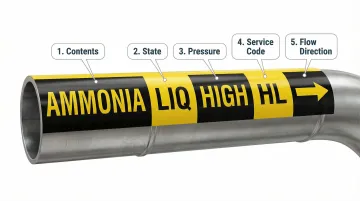
These markers apply to all piping, including insulated lines. RE&D's safety identification catalog covers pipe markers and signage to meet these requirements across your full system.
Common Valve Labeling Mistakes to Avoid
Three critical errors account for the majority of compliance gaps and emergency response failures.
Failing to Align Physical Valve Tags with P&IDs
Field tags that don't match the P&ID are a direct compliance liability — and one of the most cited gaps in OSHA ammonia refrigeration inspections. OSHA Citation 964439.015/01001 found that "labeling of ammonia service piping was not consistent" and that pipes lacked identification regarding physical state, relative pressure, and flow direction.
Solution: Conduct periodic verification audits where someone walks the system with the P&ID in hand. This is the only way to catch drift over time as modifications are made.
Assuming Small or Worn Tags Are "Good Enough"
An unreadable tag is functionally the same as no tag. Common failure points include:
- Tags buried under pipe insulation or accumulated ice
- Faded or corroded labels no longer legible at arm's length
- Tags too small to read through a respirator visor during emergency response
Solution: Tag condition should be part of routine mechanical integrity inspections, and replacement should be proactive, not reactive. Consider upgrading critical emergency shutdown valves from small hanging tags to large placards.
Labeling Only the Minimum Required Valves
If a valve is referenced in any operating or emergency procedure but isn't tagged, personnel following those procedures face unnecessary risk.
Solution: Review SOPs against the tagged valve inventory whenever procedures are updated. This best practice prevents dangerous gaps between documentation and physical reality.
Frequently Asked Questions
What are the OSHA standards for ammonia?
Ammonia refrigeration systems with 10,000 lbs or more are subject to OSHA's PSM standard (29 CFR 1910.119). All facilities handling ammonia must comply with Lockout/Tagout (29 CFR 1910.147) and HazCom. EPA's RMP rule may also apply based on quantity thresholds.
What are the requirements for ammonia piping?
Ammonia refrigerant piping must be marked per IIAR Bulletin 114 with markers identifying the refrigerant, physical state, pressure level, system abbreviation, and flow direction. ANSI/IIAR 2 governs design and installation requirements for new systems.
Can people smell ammonia in a concentration of 5 to 50 ppm?
Yes, ammonia is detectable by most people at concentrations as low as 5 ppm. The OSHA PEL is 50 ppm, and concentrations above 300 ppm are considered IDLH — making detection systems and emergency signage essential at any ammonia facility.
What information should be displayed on an ammonia refrigeration valve tag?
At minimum, each tag must carry a unique identifier that matches the P&ID. Modern tags often include valve name/type, equipment ID, room location, line designation, and valve position. However, readability in emergency conditions should guide how much information is placed on any single tag.
What signage is required on an ammonia refrigeration machinery room door?
Per ANSI/IIAR 2, machinery room entrances must display the room name, an authorized personnel restriction, a caution notice identifying ammonia (R-717), PPE requirements, and the NFPA 704 hazard diamond with appropriate ratings (3-3-0 for indoor, 3-1-0 for outdoor).
Does OSHA directly require ammonia valve tagging?
OSHA does not use the explicit phrase "valve tags" but its LOTO and PSM standards require employers to ensure employees can safely identify and operate energy controls. For facilities that have adopted IIAR standards as their RAGAGEP, the IIAR valve identification requirements become the enforceable minimum.
Need compliant valve tags, pipe markers, or machinery room signage for your ammonia refrigeration system? RE&D manufactures valve tags, pipe markers, and facility signage built to IIAR and OSHA specifications. Contact our sales team at 1-800-552-3127 or sales@redsafetyids.com to discuss your specific requirements.