Introduction
Picture this: It's 2 a.m. in a chemical processing plant when a pressure alarm sounds. A maintenance technician rushes to isolate the affected line, scanning rows of identical valves in dim emergency lighting. Without clear tags, every second of hesitation raises the risk of a catastrophic release.
That scenario isn't hypothetical. The U.S. Chemical Safety Board has documented multiple fatal incidents where misidentified valves led to explosions and toxic releases, including a Valero refinery disaster that released 49,000 pounds of flammable material.
Valve tagging isn't administrative paperwork — it's frontline safety infrastructure. This guide covers the governing standards, required tag information, ASME A13.1 color coding, material selection for harsh environments, and building a valve schedule that serves both daily maintenance and emergency response.
TLDR: Key Takeaways
- Valve tags are required for OSHA 1910.147 (Lockout/Tagout) and ASME A13.1 compliance across industrial facilities
- Complete tags display valve number, service/contents, operational status, and location identifier
- ASME A13.1 color coding ties tag colors to pipe contents—red for fire systems, yellow for flammables, green for water
- Tag material (brass, aluminum, stainless steel, or plastic) must match the environment's temperature, moisture, and chemical exposure
- A documented valve schedule is required for maintenance audits, emergency response, and regulatory compliance
What Are Valve Tags and Why Do They Matter?
Valve tags are small, durable identification markers permanently attached to valve bodies—never to handles—that communicate pipe contents, valve function, and operational status to anyone working in the facility. Unlike temporary labels or paint markings that fade, properly manufactured valve tags remain legible for decades, providing critical information during emergency shutdowns or unplanned maintenance.
Three reasons facilities implement valve tagging programs:
- Worker safety – Tags identify hazardous contents (acids, flammables, high-pressure steam) before someone opens the wrong valve
- Operational efficiency – Maintenance crews execute shutdowns and startups faster when every valve is clearly identified and cross-referenced to the valve schedule
- Regulatory compliance – OSHA 1910.147 requires specific procedures for isolating hazardous energy, which depends on unambiguous valve identification

The consequences of skipping these programs can be severe. A CSB investigation of a Dow Chemical incident found that operators started a boiler feedwater system with bleed valves inadvertently left open, releasing 670 gallons of scalding water that severely burned a worker. Clear operational status tags—"normally closed" or "open during startup only"—prevent exactly these failures.
Industries that rely heavily on valve tagging:
- Oil and gas production and refining
- Chemical processing and manufacturing
- Power generation (coal, gas, nuclear)
- Water and wastewater treatment
- HVAC systems in commercial and institutional buildings
- General manufacturing and construction
Valve Tagging Standards: ASME, OSHA, and Applicable Regulations
OSHA 1910.147: The Lockout/Tagout Foundation
No OSHA regulation explicitly mandates "valve tags" by name, but OSHA 29 CFR 1910.147(c)(4)(ii)(B) requires employers to document "specific procedural steps for shutting down, isolating, blocking and securing machines or equipment to control hazardous energy." You cannot execute specific isolation procedures if technicians can't identify which valve controls which energy source.
Valve tagging is an implied best practice under LOTO compliance—facilities that skip it fail audits and increase liability.
ASME A13.1: The Color-Coding Standard
ASME A13.1-2023 (Scheme for the Identification of Piping Systems) is the primary standard governing how pipes and their associated valves should be identified through color coding and labeling. While A13.1 technically addresses pipe markers rather than valve tags, the standard explicitly requires markers "adjacent to all valves and flanges."
Industry best practice consistently extends its color-content pairings to valve tags to maintain visual consistency from pipe to valve.
Which ASME and ISO Standards Apply to Valves?
For identification and tagging:
- ASME A13.1 governs pipe and valve identification color coding
- ISA-5.1-2024 (Instrumentation Symbols and Identification) defines alphanumeric tag numbering conventions used on P&IDs in process industries
- ISO 14617 specifies graphical symbols for valves on engineering diagrams
For valve design and performance (outside tagging scope), ASME B16.34 covers pressure-temperature ratings and manufacturer markings, while API 598 governs valve inspection and testing.
Physical valve tags must display the exact alphanumeric identifiers from P&IDs (per ISA-5.1) to eliminate translation errors between engineering drawings and the plant floor.
Valve Inspection Standards and Traceability
API 598 (valve testing) and ASME B31.3 (process piping) both require valves to be traceable and identifiable during inspections. Inspectors cross-reference the valve number on the physical tag against the valve schedule and maintenance history—without proper tagging, facilities cannot demonstrate inspection compliance or track maintenance intervals.
Facility-Specific Standards
ANSI Z535.1 governs safety color codes broadly and may apply to background banding on piping near valves. Additionally, institutional owners like universities and hospitals often layer facility-specific requirements on top of baseline standards—for example, CMU Facilities Management publishes detailed valve tagging specifications that mandate valve schedules, tag placement, and attachment methods.
Color Coding Under ASME A13.1
The ASME A13.1 color-coding system allows workers to make safety-critical decisions at a glance. Valve tags should match the pipe marker color scheme used throughout the facility so identification is consistent from pipe label to valve body.
ASME A13.1 Color-Content Pairings:
| Fluid Classification | Background Color | Text Color | Example Applications |
|---|---|---|---|
| Fire-Quenching Fluids | Safety Red | White | Sprinkler systems, fire hydrants, standpipes |
| Toxic and Corrosive Fluids | Safety Orange | Black | Sulfuric acid, caustic soda, ammonia |
| Flammable and Oxidizing Fluids | Safety Yellow | Black | Gasoline, natural gas, oxygen, hydrogen |
| Combustible Fluids | Safety Brown | White | Fuel oil, diesel, lubricating oil |
| Potable, Cooling, Boiler Feed | Safety Green | White | Drinking water, chilled water, boiler feedwater |
| Compressed Air | Safety Blue | White | Instrument air, plant air, breathing air |
| User-Defined | Safety Purple | White | Facility-specific systems |
| User-Defined | Safety Gray | White | Facility-specific systems |
| User-Defined | Safety Black | White | Facility-specific systems |
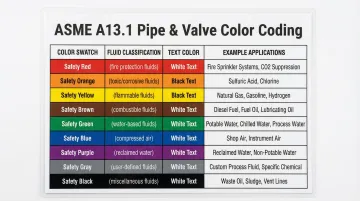
When tag colors match this matrix facility-wide, a mismatched tag becomes an immediate visual flag—prompting verification before anyone touches the valve.
What Information Should a Valve Tag Display?
Minimum Required Information
A standard valve tag must include four core data elements:
Valve number: A unique identifier assigned sequentially across the facility, never restarted by system or building. This is the tag's primary identifier and must match the valve schedule exactly.
Service term and abbreviation: What the pipe carries, expressed in standardized facility abbreviations. Because no universal standard exists for service abbreviations, each facility must maintain its own abbreviation dictionary. Common examples:
- CHWS = Chilled Water Supply
- CHWR = Chilled Water Return
- HWS = Hot Water Supply
- COND = Condensate Return
Operational status: Indicates whether the valve is always open, normally open or closed by season, or has a specific isolation role. Without this, operators risk changing valve positions during routine inspections without realizing the consequences.
Location identifier: Combines building code, valve number, and service abbreviation into a unique reference. For example, MU-176-CHWR identifies valve 176 in building MU on the chilled water return line.
Valve Numbering Conventions
Number valves consecutively across the entire facility. Never restart numbering by building or system, as duplicate numbers undermine the valve schedule's reliability as a single authoritative reference. The numbering sequence must be reflected in the valve schedule so technicians can cross-reference quickly during maintenance or emergency response.
Getting the numbering convention right from the start pays off when facilities grow — adding new valves to a sequential facility-wide system is straightforward, while patching a fragmented system is not.
Tag Placement and Attachment
Where and how a tag is attached determines whether it survives long-term. Follow these rules:
- Attach tags to the valve body or bonnet — never to the handle or wheel, which may be removed or replaced during maintenance
- Orient tags to face foot traffic and inspection paths for maximum visibility
- Use stainless steel wire or chain through the tag's mounting hole to prevent loss
Advanced Tag Data for Digital Integration
In complex facilities, additional data may appear on tags or be linked via QR code or barcode:
- Last inspection date
- Torque requirements for reopening
- Associated P&ID drawing number
- Maintenance interval or next service due date
Linking tags to a Computerized Maintenance Management System (CMMS) gives technicians instant mobile access to maintenance histories and procedures by scanning the tag — no binder required.
Valve Tag Materials: Matching the Tag to the Environment
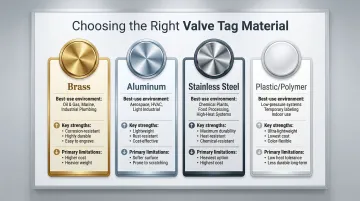
Selecting the wrong material compromises safety and wastes maintenance budgets. No single material resists all corrosive situations—environmental exposure, mechanical properties, and life expectancy all influence selection.
Four Primary Valve Tag Materials
| Material | Best For | Strengths | Limitations |
|---|---|---|---|
| Brass | Indoor plumbing, HVAC, mechanical rooms | Easy to stamp or engrave; moderate corrosion resistance | Tarnishes in acidic or highly corrosive atmospheres |
| Aluminum | Outdoor installations, moderate chemical exposure | Lightweight, rust-resistant, cost-effective | Galvanic corrosion risk near dissimilar metals; vulnerable to strong alkalis |
| Stainless Steel | Chemical plants, offshore facilities, high-heat or high-humidity environments | Superior corrosion resistance; withstands extreme temperatures; longest service life | Higher upfront cost and engraving expense |
| Plastic/Polymer | Low-hazard indoor applications (commercial HVAC, office buildings) | Cost-effective, lightweight, chemically resistant | Degrades under UV or extreme heat; less durable under mechanical abrasion |
Environmental Factors Driving Material Selection
Consider these factors when specifying tag materials:
- Ambient temperature range (cryogenic to high-heat steam lines)
- Exposure to moisture or standing water
- Proximity to corrosive chemicals (acids, caustics, solvents)
- UV exposure for outdoor installations
- Mechanical abrasion from foot traffic or equipment movement
Engineers rely on ASTM standards to evaluate material durability: ASTM G154 tests UV exposure, ASTM D543 assesses chemical resistance, and ASTM B117 evaluates salt spray corrosion for marine environments.
Custom Tag Manufacturing
Facilities with non-standard tag sizes, unusual environmental demands, or specialty materials that fall outside standard catalog offerings can work with RE&D to manufacture custom valve tags. This is particularly relevant for operations in offshore, cryogenic, or high-acid environments where off-the-shelf options often fall short on durability or legibility.
Valve Tag Installation Best Practices and Building a Valve Schedule
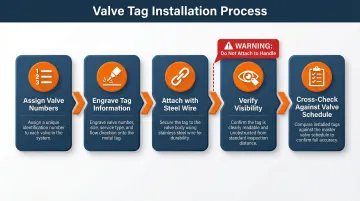
Step-by-Step Installation Process
1. Assign valve numbers sequentially before any tags are produced. Document all assignments in the valve schedule draft.
2. Engrave or stamp required information onto metal tags. Do not use paint or adhesive labels in industrial environments—engraving is the durability standard. For plastic tags, use laser engraving or mechanical engraving, not printed labels.
3. Attach using steel wire or stainless chain through the tag's hole to the valve body (not the handle). Ensure the attachment is secure but allows the tag to rotate for visibility.
4. Verify visibility from the primary access direction. Tags should be readable without moving equipment or climbing.
5. Cross-check installed tags against the valve schedule before sign-off. Any discrepancies must be corrected immediately.
What Is a Valve Schedule and Why Is It Required?
A valve schedule is a complete, documented register of every valve in the facility, listing:
- Valve number (unique identifier)
- Service controlled (pipe contents)
- Physical location (building, room, elevation)
- Area or space served
- Color code (per ASME A13.1)
- Operational status (normally open/closed)
- Associated P&ID drawing number
Best practice requires the valve schedule to be posted at or near the mechanical room entry, maintained in a loose-leaf binder with protective sleeves, and updated any time a valve is added, replaced, or re-designated. The schedule is the authoritative reference for maintenance crews, inspectors, and emergency responders.
Regular Valve Tag Audits
Conduct periodic tag audits as part of preventive maintenance:
- Inspect tags for legibility, corrosion, or physical damage
- Replace damaged tags immediately using the same valve number to preserve schedule integrity
- Document audits with date, inspector name, and corrective actions taken
- Update the valve schedule to reflect any changes
Digital Asset Management Integration
Audit findings are only as useful as the system that houses them. Facilities managing large numbers of valves increasingly integrate valve tags with digital asset management systems — QR codes or barcodes engraved directly onto tags link each valve to its maintenance history, P&ID reference, and LOTO procedure in the CMMS, eliminating dependence on paper schedules.
Technicians scan the tag with a mobile device and pull up maintenance records and LOTO procedures on the spot. Work orders trigger automatically, and inspection logs update in real time — keeping compliance documentation current without manual data entry.
Frequently Asked Questions
What ASME and ISO standards apply to valves and valve tagging?
ASME A13.1 governs pipe and valve identification color coding, ISA-5.1 governs instrumentation and valve symbology in process industries, and ASME B31.3 governs process piping. All three require valves to be identifiable and traceable, making proper tagging and a complete valve schedule prerequisites for passing inspection audits.
What are the standards for valve inspection?
API 598 covers valve testing and inspection, and ASME B31.3 governs process piping. Both require valves to be identifiable and traceable, making proper tagging and a complete valve schedule prerequisites for passing inspection audits.
What does DN20 mean on a valve?
DN stands for Diameter Nominal (from the French "Diamètre Nominal"), an ISO 6708 standard measurement of pipe/valve size. DN20 indicates a nominal diameter of approximately 20mm (roughly 3/4-inch NPS) — a body specification marking, not the same as the identification tag attached to the valve for operational tracking.
What information should be included on a valve tag?
A complete valve tag includes:
- Valve number — unique identifier
- Service term and abbreviation — pipe contents
- Operational status — normally open or closed
- Location identifier — building code, valve number, and service
Some facilities also add inspection dates or P&ID references.
What material is best for industrial valve tags?
Stainless steel or brass for high-temperature, chemical, or outdoor environments; aluminum for moderate conditions; plastic only for low-hazard, climate-controlled indoor installations. Engraved metal tags outperform printed labels for long-term legibility and durability.
Do OSHA regulations require valve tags?
OSHA does not have a specific regulation mandating valve tags. However, OSHA 1910.147 (Lockout/Tagout) and general duty clause requirements make clear that valve identification is an essential component of any compliant energy isolation and hazardous energy control program.