: A Complete Guide](https://file-host.link/website/redsafetyids-efu5fj/assets/blog-images/9a31867a-accc-490a-92c3-d6f2892ce62f/1773157939506603_1e5ff97be11f4d1784ead2371a7f2ae3/360.webp)
Introduction
Every time an excavator breaks ground, they're working near a hidden network of utilities—electric lines, gas pipes, water mains, and communication cables. One wrong strike can cause injury, service outages, or environmental damage. According to the Common Ground Alliance (CGA) 2024 DIRT Report, there were 196,977 unique reported damages to buried utilities, with telecommunications (49%) and natural gas (39%) accounting for 88% of all strikes.
Underground warning tape color codes are the standardized first line of defense against these incidents. Knowing which color means what—and how to use tape correctly—is essential for anyone working on or near excavation sites. This guide covers:
- The APWA color code system and all 8 utility colors
- Detectable vs. non-detectable tape types
- Depth and installation requirements
- Applicable standards and regulations
- Common mistakes to avoid on excavation sites
Key Takeaways
- Underground warning tape is buried above utility lines to alert excavators before they reach the utility itself
- The APWA Uniform Color Code defines 8 standard colors, each assigned to a specific utility type (red = electrical, yellow = gas/oil, blue = potable water)
- Detectable tape contains an aluminum foil core that can be located with a metal detector; non-detectable tape is visual-only and the lower-cost alternative
- Tape width must match burial depth: 2-inch for shallow installs, up to 6-inch for deep installations
- Wrong color, type, or burial depth can trigger compliance violations, worker injury, and costly utility damage
What Underground Warning Tape Color Codes Are — and Why They Matter
Underground warning tape is a polyethylene or foil-laminate film buried above underground utilities during installation. It's designed to intercept excavation equipment before it reaches the utility line and serve as a visual or detectable warning.
Color codes follow a standardized identification system governed by the American Public Works Association (APWA) Uniform Color Code, which assigns each utility type a specific color. This ensures crews, contractors, and locators can interpret warnings consistently, regardless of who performed the installation.
The Functional Role of Tape
Warning tape is a passive warning layer within the broader utility protection system. It supplements utility locating calls like 811, surface markings, and engineering drawings rather than replacing them. The color code performs two physical jobs simultaneously:
- Communicating what is buried below at the moment of dig-in
- Deterring further excavation until the utility can be safely confirmed and avoided
Compliance and Standards
Color-coded tape is required or recommended by multiple federal and industry standards, including:
- OSHA excavation regulations
- DOT pipeline safety regulations
- APWA guidelines
Correct color selection is a compliance requirement — one that carries regulatory weight under federal and industry rules.
The Complete APWA Color Code: All 8 Colors Explained
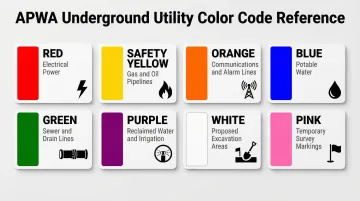
The APWA system defines 8 colors, each assigned to a distinct utility category. Printed legends (e.g., "CAUTION: ELECTRIC LINE BELOW") should accompany the color to eliminate ambiguity.
| Color | Utility Category |
|---|---|
| 🔴 Red | Electrical power lines, cables, conduit, and lighting |
| 🟡 Yellow | Gas, oil, steam, petroleum, and gaseous materials |
| 🟠 Orange | Communication, alarm, signal lines, and fiber-optic |
| 🔵 Blue | Potable water lines |
| 🟢 Green | Sewer and drain lines |
| 🟣 Purple | Reclaimed water, irrigation, and slurry lines |
| ⬜ White | Proposed excavation boundaries |
| 🩷 Pink | Temporary survey markings |
Red — Electrical Power Lines, Cables, Conduit, and Lighting Cables
Red tape marks all electric power infrastructure—high-voltage lines, distribution cables, conduit, and lighting systems. Accidental contact with energized lines is a leading cause of excavation fatalities. Treat every red-marked line as energized until confirmed otherwise.
Yellow — Gas, Oil, Steam, Petroleum, and Other Gaseous Materials
Yellow marks flammable and hazardous energy pipelines. Damaging a yellow-marked line can trigger gas leaks, fires, or explosions — consequences that make pre-dig verification non-negotiable.
Orange — Communication, Alarm, or Signal Lines, Cables, or Conduit
Orange covers telecommunications, fiber-optic, internet, telephone, alarm, and signal infrastructure. While orange-line strikes are less immediately life-threatening than red or yellow, they can cause widespread communication outages and significant financial liability.
Blue — Potable Water Lines
Blue marks clean drinking water distribution lines. A damaged water main can disrupt service, compromise water quality, and trigger public health consequences depending on the extent of the break.
Green — Sewer and Drain Lines
Green marks wastewater and stormwater drainage infrastructure. Strikes here can cause sewage backups and ground contamination — problems that are slow to remediate and costly to repair.
Purple — Reclaimed Water, Irrigation, and Slurry Lines
Purple marks non-potable water used for irrigation and industrial processes. It occasionally appears on general-purpose lines that don't fit another category, so a printed legend is especially important here.
White — Proposed Excavation Area
White is used to mark the boundaries or centerline of a proposed dig area before work begins. It defines where excavation will occur, not what utility lies below.
Pink — Temporary Survey Markings
Pink indicates temporary survey points or unknown utilities. Pink markings are provisional and should prompt additional investigation before excavation proceeds.
Detectable vs. Non-Detectable Underground Warning Tape
Detectable Underground Warning Tape
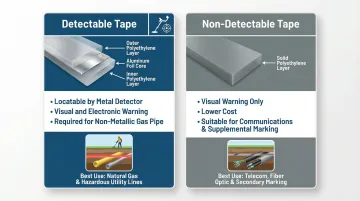
Detectable tape incorporates a solid aluminum foil core (typically 0.35 mil) laminated between polyethylene layers, resulting in an overall thickness of 4.5 to 5.0 mil. This metallic core allows a metal detector or locating wand to identify the tape's position from the surface—even when buried below grade.
Key features:
- Can be located using pipe-and-cable locators or metal detectors
- Provides both visual and electronic warning
- Required for non-metallic pipes under federal regulations
Non-Detectable Underground Warning Tape
Unlike detectable tape, non-detectable tape contains no metallic component — it's a visual-only product made from inert low-density polyethylene (LDPE) film (typically 4.0 mil thickness). It can only be found by physical excavation, making it suitable for lower-risk or shallower installations.
Key features:
- Visual warning only during excavation
- Lower cost than detectable tape
- Suitable for communication lines or supplemental marking
When to Use Each Type
Choosing between the two types comes down to utility risk level, burial depth, and regulatory requirements. The table below outlines the most common applications for each.
| Tape Type | Best For |
|---|---|
| Detectable | Gas, electrical, high-pressure water, deeper installations |
| Non-Detectable | Communication lines, supplemental marking, shallower runs |
Federal mandate: PHMSA 49 CFR §192.321(e) requires unencased plastic gas pipe to have an "electrically conducting wire or other means of locating the pipe underground." Detectable tape satisfies this requirement, making it the standard choice for plastic gas pipe installations.
Shared Material Properties
Both detectable and non-detectable tapes share critical durability features:
- Acid and alkali resistance for extended underground use
- Inert polyethylene film designed to resist degradation in soil
- Lead-free, heavy-metal-free construction
- Fade-resistant printed legends
RE&D manufactures and distributes both detectable and non-detectable underground warning tape in APWA-compliant colors. For technical specifications or custom requirements, contact RE&D at 1-800-552-3127 or sales@redsafetyids.com.
Burial Depth, Tape Width, and Installation Requirements
Tape Width-to-Depth Guidelines
Tape width must scale with burial depth to ensure detection probability. Industry-standard guidelines:
| Tape Width | Maximum Burial Depth |
|---|---|
| 2 inches | Up to 12-14 inches |
| 3 inches | Up to 24 inches |
| 6 inches | Up to 36 inches |
Wider tape increases detection probability at greater depths for detectable models.
Correct Placement
Tape should be installed approximately 12 inches above the utility line—not directly on the line. This offset ensures that an excavator encounters the tape warning before reaching the utility itself.
Tape placed too deep loses effectiveness for both visual detection and metal detector range — placement depth matters as much as color coding.
Applicable Standards and Regulations
| Standard/Regulation | Scope | Requirement |
|---|---|---|
| PHMSA 49 CFR §192.321(e) | Gas distribution (plastic pipe) | Mandatory: Requires "electrically conducting wire or other means of locating" |
| OSHA 29 CFR 1926.651(b) | All construction excavations | Mandatory: Requires determining exact location by safe means |
| ASME B31.8 | Gas transmission & distribution | Advisory: Recommends buried warning tape above pipe |
| API RP 1109 | Liquid petroleum pipelines | Advisory: Lists buried tape as acceptable supplemental marker |
The APWA 18-Inch Tolerance Zone
The CGA and APWA define the "Tolerance Zone" as the width of the facility plus 18 inches measured horizontally from each side of the outside edge. Any excavation within this zone must be performed with non-powered hand tools or vacuum excavation until the facility is exposed.
Common Mistakes to Avoid with Underground Warning Tape
Using the Wrong Color or Skipping Printed Legends
A mismatched color can send excavators to the wrong utility protocol. Relying on color alone without a printed warning message increases misidentification risk—especially for purple tape where reclaimed water and general-purpose uses overlap.
Solution: Always use APWA-compliant colors with clear printed legends.
Assuming Tape is a Complete Safety Solution
Warning tape is a supplement, not a replacement, for:
- 811 locating calls
- Utility maps
- Field marking
- Test-holing
Older infrastructure may predate color-coded tape standards. Decades-old tape may have faded, shifted, or deteriorated. OSHA 29 CFR 1926.651(b)(3) explicitly requires determining the exact location of underground installations by "safe and acceptable means" when excavation approaches estimated locations.
Solution: Always verify with 811 locating services regardless of whether tape is encountered.
Installing Tape at the Wrong Depth
Depth errors fall into two categories, each with real consequences:
- Burying tape too deep (beyond the detection range for the tape width used) renders detectable tape unlocatable by standard instruments
- Burying it too shallow risks the tape being disrupted before it can serve its warning function
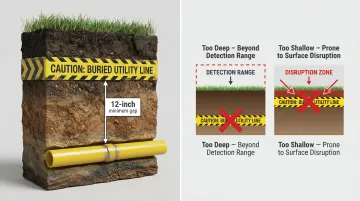
Solution: Follow the width-to-depth guidelines strictly and place tape 12 inches above the utility line.
Ignoring Private Utility Blind Spots
811 locators only mark public utilities up to the meter or point of service. Private utility lines—such as private water/sewer laterals, irrigation systems, and electrical lines running between private buildings—are not marked by 811.
Solution: Hire private utility locators for comprehensive site assessment and install detectable warning tape on all newly constructed private lines.
Frequently Asked Questions
What is the APWA color code for underground warning tape?
The APWA Uniform Color Code assigns 8 colors to utility types: red (electric), yellow (gas/oil), orange (communications), blue (potable water), green (sewer), purple (reclaimed water/irrigation), white (proposed excavation), and pink (temporary survey markings). This standardized system ensures consistent interpretation across all job sites.
What is the difference between detectable and non-detectable underground warning tape?
Detectable tape contains a 0.35 mil aluminum foil core that can be located with a metal detector before excavation reaches the utility. Non-detectable tape is a visual-only polyethylene film that can only be found during physical digging. Detectable tape is required for non-metallic gas pipes under federal law.
How deep should underground warning tape be buried?
Burial depth depends on tape width: 2-inch tape for depths up to 12-14 inches, 3-inch tape for depths up to 24 inches, and 6-inch tape for depths up to 36 inches. Tape should always be placed approximately 12 inches above—not directly on—the utility line to provide early warning.
Is underground warning tape required by law?
PHMSA 49 CFR §192.321(e) requires detectable marking for unencased plastic gas pipe, while OSHA 29 CFR 1926.651 mandates safe location of underground installations during excavation. Requirements vary by utility type, depth, and jurisdiction—always verify applicable codes for your project location.
Can one color of tape be used for multiple utility types?
No. Each color is assigned to a specific utility category under the APWA standard. Mixing colors or using the wrong color undermines the system's safety purpose and can lead to catastrophic misidentification. Printed legends on the tape add a second layer of identification to reduce ambiguity.
What happens if underground warning tape is damaged or missing?
Absent or degraded tape removes the pre-strike warning layer entirely, increasing the risk of utility damage during excavation. Missing tape does not mean no utility is present—crews should always verify with 811 locating services and conduct test-holing within the tolerance zone regardless of whether tape is encountered.
Need underground warning tape that meets APWA standards? RE&D manufactures both detectable and non-detectable underground warning tape with over 33 years of experience in safety identification products. Contact us at 1-800-552-3127 or sales@redsafetyids.com to discuss your project requirements and specifications.