Introduction
In a busy manufacturing facility, tape does far more than hold boxes together. It bonds components, marks safety zones, seals ducts, and protects surfaces — and choosing the wrong type can trigger adhesive failure, OSHA violations from degraded floor markings, or costly production downtime.
According to the Pressure Sensitive Tape Council, pressure-sensitive tape is engineered to meet specific performance thresholds that consumer tape simply cannot match.
This guide covers the major types of industrial tape used in manufacturing, what sets each one apart, and how to match the right tape to your application.
Key Takeaways
- Using the wrong industrial tape causes adhesive failure, safety hazards, or compliance violations
- Six key types covered: masking, safety/floor marking, foam, foil, filament/strapping, and double-sided/bonding tape
- Selection depends on substrate, environment (temperature, moisture, UV), permanence, and load requirements
- Surface preparation matters as much as tape choice — contaminated surfaces cause even quality tape to fail
What Is Industrial Tape?
Industrial tape is a pressure-sensitive adhesive (PSA) applied to a carrier or backing material. The backing determines physical properties like strength, flexibility, and heat resistance, while the adhesive determines bond strength and surface compatibility.
Three primary adhesive chemistries dominate industrial applications:
- Acrylic — Broad temperature capability (-40°F to 300°F) with superior UV resistance and long-term environmental durability. Builds bond strength slowly but achieves the highest ultimate hold
- Rubber-Based — Fast initial tack with strong adhesion to low-surface-energy (LSE) substrates like polyethylene. Less durable under UV exposure and temperature extremes
- Hot Melt — High initial tack and consistent adhesion; most common in packaging and label applications
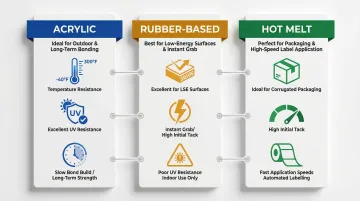
Unlike consumer tape, industrial tape is engineered to meet specific performance standards: tensile strength, temperature ranges, chemical exposure, UV resistance, and regulatory compliance such as OSHA floor-marking standards. Getting the chemistry and backing combination wrong can mean premature failure, safety hazards, or non-compliance — which is why understanding each tape type matters before specifying one for a job.
Why Industrial Tape Matters in Manufacturing
Tape replaces or supplements traditional mechanical fasteners — bolts, rivets, and welds — across many manufacturing applications. It distributes stress evenly across a surface, reduces weight, and avoids surface damage in ways mechanical fasteners can't.
What goes wrong when the wrong tape is used:
- Adhesive failure mid-process causes rework and material waste
- Improper floor markings create OSHA compliance violations
- Inadequate sealing allows moisture or contamination to enter packaged goods
- Overly aggressive adhesives cause surface damage during removal
Beyond assembly, floor marking and hazard identification tapes serve as visual communication tools on the production floor — directly supporting accident prevention and regulatory compliance. OSHA 1910.144 designates yellow as the standard color for marking physical hazards such as tripping and falling zones.
Types of Industrial Tape Used in Manufacturing
Industrial tape is not a single-category product. It exists in specialized types, each engineered for a distinct function, surface type, or environmental condition in manufacturing.
Masking Tape
Masking tape is a paper-backed, pressure-sensitive tape with a low-to-medium tack adhesive designed for temporary application. It protects surfaces during painting, coating, and powder coating processes and removes cleanly without leaving residue. Its low-tack adhesive is engineered for clean removal, not permanent hold.
Best suited for:
- Surface masking during spray painting or powder coating on metal components
- Color coding of parts during assembly staging
- Light-duty bundling and labeling workpieces during processing
- Outdoor applications up to 14 days with UV-resistant variants
General-purpose industrial masking tapes typically resist temperatures up to 150°F (66°C) for 30 minutes. High-temperature variants designed for paint baking withstand surface temperatures up to 300°F (150°C) for 30 minutes.
Key strengths: Clean removal capability protects surfaces without damage. Most industrial masking tapes offer clean removal within 1 to 3 days.
Limitations: Not suitable for permanent bonding, high-temperature environments beyond rated range, or wet/outdoor exposure without a UV-rated variant.
Safety and Floor Marking Tape (Vinyl Tape)
Vinyl safety tape is a durable, color-coded, conformable tape engineered for permanent or semi-permanent floor and surface marking in industrial and manufacturing facilities. It communicates hazards, traffic lanes, workstation boundaries, and equipment zones visually. Its primary function is visual communication and OSHA compliance.
Primary applications:
- Marking aisles, walkways, safety perimeters, and hazardous zones to meet OSHA 1910.22 standards
- Equipment staging areas and traffic control
- Hazard identification and color-coded visual communication
- Forklift traffic lanes and pedestrian zones
Standard vinyl tapes (5.2 to 5.4 mils thick) in heavy forklift traffic may deteriorate and require replacement monthly. Heavy-duty floor marking tapes (19 to 32 mils thick) can last over 7 months with minimal replacement in heavy traffic environments.
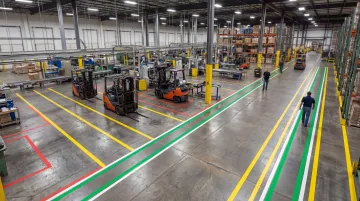
Key strengths: High visibility, durability underfoot, resistance to cleaning chemicals, and ability to write on or print over the tape surface for additional identification.
Limitations: Vinyl tape can degrade if exposed to prolonged outdoor UV light without a UV-rated formulation. Improper surface preparation (oil, moisture, dust) will cause premature adhesion failure.
Foam Tape
Foam tape is a single- or double-sided tape with a foam carrier (polyethylene, polyurethane, or acrylic foam) that provides cushioning, sealing, and vibration dampening in addition to bonding. Its foam core fills gaps and conforms to uneven surfaces rather than just adhering flat.
Best suited for:
- Gasketing and sealing applications (door frames, enclosures, HVAC panels)
- Vibration dampening between metal components
- Mounting signs or panels to irregular surfaces
- Bonding in automotive assembly where mechanical fasteners would create stress points
Used extensively in HVAC, automotive, electronics, and construction sub-assembly. Acrylic foam tapes (e.g., 3M VHB 5952) offer short-term temperature resistance up to 300°F (149°C) and long-term resistance up to 200°F (93°C).
Key strengths: Fills surface gaps, absorbs vibration, provides an air- and weather-tight seal, and bonds to irregular surfaces.
Limitations: Not suited for high-shear or heavy-load structural applications. Temperature extremes can compress the foam permanently, reducing sealing performance over time.
Foil Tape
Foil tape features a thin metallic backing — commonly aluminum, copper, or lead — laminated to a pressure-sensitive adhesive. The metallic backing provides heat reflectivity, electrical conductivity or shielding, and vapor/moisture barrier properties that plastic or paper backings cannot offer.
Best suited for:
- HVAC duct sealing and seaming (aluminum foil tape meets UL 181 standards)
- Heat reflection and insulation jacketing
- Vapor barrier sealing in building and manufacturing applications
- EMI/RFI shielding in electronics (copper foil tape)
UL 181 certification requires tapes to pass tests for tensile strength, peel adhesion, shear adhesion, 60-day mold growth and humidity, and temperature/pressure cycling. Typical UL 181 listed aluminum foil tapes operate in ranges from -40°F to 300°F (-40°C to 149°C).
Key strengths: Excellent temperature resistance, heat reflectivity, moisture and vapor barrier performance, and conductive properties.
Limitations: More expensive than cloth or film alternatives. Can crack if over-bent. Aluminum foil tape is not UV-stable for outdoor permanent applications unless specifically rated.
Filament and Strapping Tape
Filament tape is a heavy-duty tape reinforced with fiberglass filaments embedded in a polypropylene or polyester film backing, providing exceptional tensile strength along the tape's length. The embedded filaments allow it to resist tearing and handle bundling loads that would cause standard tape to snap.
Best suited for:
- Palletizing and bundling heavy materials (pipes, lumber, metal extrusions)
- Reinforcing large cartons for heavy-duty shipping
- Securing skids or equipment during transport
- Distribution centers and construction material handling
Industrial filament tapes exhibit high tensile strengths ranging from 105 lbs/in width (utility grade) to 380 lbs/in width (high performance).
Key strengths: Very high tensile strength, tear-resistant, suitable for heavy-duty bundling without a dispenser tool in many cases.
Limitations: Not hand-tearable — requires a knife or dispenser to cut. Not suitable for surface protection or sealing applications. Can be difficult to remove from surfaces cleanly.
Double-Sided and Structural Bonding Tape
Double-sided tape features adhesive on both surfaces of a carrier (or a transfer tape with no carrier), designed to bond two surfaces together invisibly without visible fasteners. High-performance versions use acrylic foam cores to create structural-strength bonds capable of replacing rivets, screws, or welds in many assemblies.
Best suited for:
- Bonding panels, trim, nameplates, and gaskets in automotive and electronics assembly
- Mounting components where fastener visibility is undesirable
- Applications requiring vibration resistance
- Sign mounting, façade bonding, and metal panel attachment (ultra-high-bond variants)
Leading structural tapes demonstrate overlap shear strengths of 80 lb/in² (550 kPa), normal tensile strengths of 70 lb/in² (480 kPa), and 90° peel adhesion of 22 lb/in (39 N/cm).
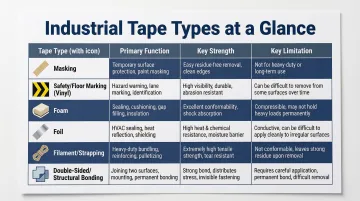
Key strengths: Eliminates surface drilling or fastener holes, distributes stress evenly across the bonded area, provides vibration and impact resistance, and allows bonding of dissimilar materials (metal to plastic, foam to metal).
Limitations: Surface preparation is critical — contamination or low surface energy substrates will prevent proper bonding. Temperature extremes can reduce shear strength. Structural bonds are difficult to reverse once cured.
How to Choose the Right Industrial Tape for Your Application
The right tape is determined by application requirements, not by brand familiarity or what's already on the shelf. Three questions drive every good selection: What does the tape need to do? What environment will it live in? How long does it need to perform?
Surface and Substrate Type
Different backings and adhesive chemistries bond differently to metal, plastic, concrete, wood, and low-surface-energy substrates.
Matching adhesive chemistry to substrate:
- Acrylic adhesives — Best for high surface energy (HSE) materials like metals and glass, long-term permanent bonding, high temperatures, and UV/chemical exposure
- Rubber-based adhesives — Best for low surface energy (LSE) materials like polypropylene and polyethylene, high initial tack, and indoor applications where extreme temperature or UV resistance is not required
- Silicone adhesives — Best for extreme high/low temperatures and bonding to silicone substrates
Substrate surface energy determines an adhesive's ability to "wet out" and form a bond. High surface energy materials (metals, glass) allow adhesives to flow easily. Low surface energy materials (polypropylene, TPO, PTFE) resist adhesive flow, resulting in weak bonds unless specialized LSE adhesives or chemical adhesion promoters are used.
Environmental Conditions
Consider these factors before selecting:
- Most industrial tapes require application at 50°F (10°C) minimum — below this threshold, the adhesive becomes too firm to bond effectively
- Select tapes rated for wet environments or chemical contact if moisture or chemical exposure is a factor
- Standard indoor tapes degrade rapidly outdoors; UV-rated formulations are required for exterior use
- Assess whether the tape will experience shear, peel, or tension loads and match mechanical ratings accordingly
Tapes that perform in a climate-controlled assembly room may fail in a cold warehouse or near heat-generating equipment.
Permanence and Removability Requirements
"Permanent" and "removable" are non-negotiable selection criteria. Temporary masking and safety floor marking tapes behave differently from structural bonding tapes. Using a permanent tape where removal is needed risks surface damage; using a temporary tape in a structural application is a safety hazard.
Regulatory and Compliance Requirements
Certain manufacturing environments require tapes that meet specific standards:
- OSHA 1910.22 for floor markings
- UL 181 for HVAC duct sealing
- RoHS/halogen-free requirements in electronics manufacturing
Selecting a tape without verifying compliance can create liability. For OSHA 1910.22 floor marking requirements specifically, RE&D manufactures custom safety identification products — including floor marking solutions — for manufacturing and construction environments. Reach them at sales@redsafetyids.com or 1-800-552-3127.
Common Mistakes When Selecting Industrial Tape
Choosing Tape by Price or Availability
A cheaper masking tape used for high-temperature powder coating, or a standard carton tape used for structural assembly, will fail and cost more in rework than a properly specified tape would have. Performance specifications should drive selection, not shelf availability.
Skipping Surface Preparation
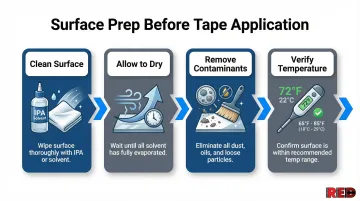
The most common cause of tape adhesion failure in manufacturing is applying tape to contaminated, oily, damp, or dusty surfaces. Even the highest-performance tape will fail on an improperly prepared substrate. Get the surface right first — then select the tape.
Surface preparation best practices:
- Clean surfaces with isopropyl alcohol or approved solvent
- Allow surfaces to dry completely before application
- Remove dust, oil, moisture, and loose particles
- Verify surface temperature is within application range
Ignoring Temperature and Environmental Ratings
Beyond surface prep, environmental conditions are just as likely to cause premature tape failure. Always verify a tape's ratings for the specific environment it will be used in — not just its general application category. Three specifications matter most:
- Temperature range: Does it hold at your process temps, including peak exposure?
- UV resistance: Will it degrade under sunlight or UV curing equipment?
- Chemical compatibility: Will solvents, coatings, or cleaning agents break down the adhesive?
A tape rated for indoor ambient conditions can degrade quickly in an outdoor installation or high-heat production environment.
Conclusion
Industrial tape is an engineered tool, and each type is purpose-built for specific applications, surfaces, and environmental conditions. Choosing the wrong tape for a job can mean adhesion failures mid-shift, safety hazards on the floor, or gaps in compliance documentation — problems that are far more costly than the tape itself.
Match your tape selection to the application requirements, environmental conditions, and any relevant compliance standards. For complex or custom requirements, a specialist supplier will help you avoid costly trial and error. If your facility needs floor marking tape, safety identification products, or custom solutions for your manufacturing or construction environment, Rodgers Enterprises and Distributors Inc. (RE&D) has been serving industrial clients since 1992. Reach them at 1-800-552-3127 or sales@redsafetyids.com.
Frequently Asked Questions
What are the three types of tapes?
The three common structural categories are single-coated (adhesive on one side), double-coated (adhesive on both sides), and transfer tape (adhesive only, no carrier). Within industrial tape, types are more often classified by function or backing material — such as masking, foil, foam, and filament.
What is industrial tape used for?
Industrial tape serves multiple functions across manufacturing environments:
- Surface protection and masking
- Bonding and assembly (replacing fasteners)
- Safety and floor marking for OSHA compliance
- Sealing (HVAC ducts, vapor barriers)
- Bundling, strapping, and vibration dampening
The application determines which tape type is appropriate.
What is the difference between industrial tape and regular tape?
Industrial tapes are engineered to meet specific performance thresholds — tensile strength, temperature resistance, adhesive chemistry, regulatory compliance — while consumer tapes are designed for light-duty general use. Using consumer tape in industrial applications typically leads to premature adhesion failure.
What type of tape is best for floor marking in manufacturing?
Vinyl tape is the standard for industrial floor marking due to its durability, color-coding capability, and resistance to forklift traffic and cleaning chemicals. It must comply with OSHA 1910.22 standards for walking-working surface demarcation — heavy-duty variants (19 to 32 mils thick) perform best in high-traffic areas.
Can industrial tape replace screws, bolts, or rivets in manufacturing?
High-bond double-sided and structural acrylic foam tapes are engineered to replace mechanical fasteners in many assembly applications — they distribute stress more evenly and resist vibration. However, structural load requirements, substrate type, and environmental conditions must be assessed before substituting tape for fasteners.
How long does industrial tape last in a manufacturing environment?
Service life depends on tape type and environment. Structural bonding and foil tapes can last years when properly applied, while floor marking tapes range from months to years based on traffic volume. Masking tapes are temporary — typically rated for 1 to 14 days depending on UV exposure.